Iran War Oil Shock Hammers Semiconductor Basket Across Every Node
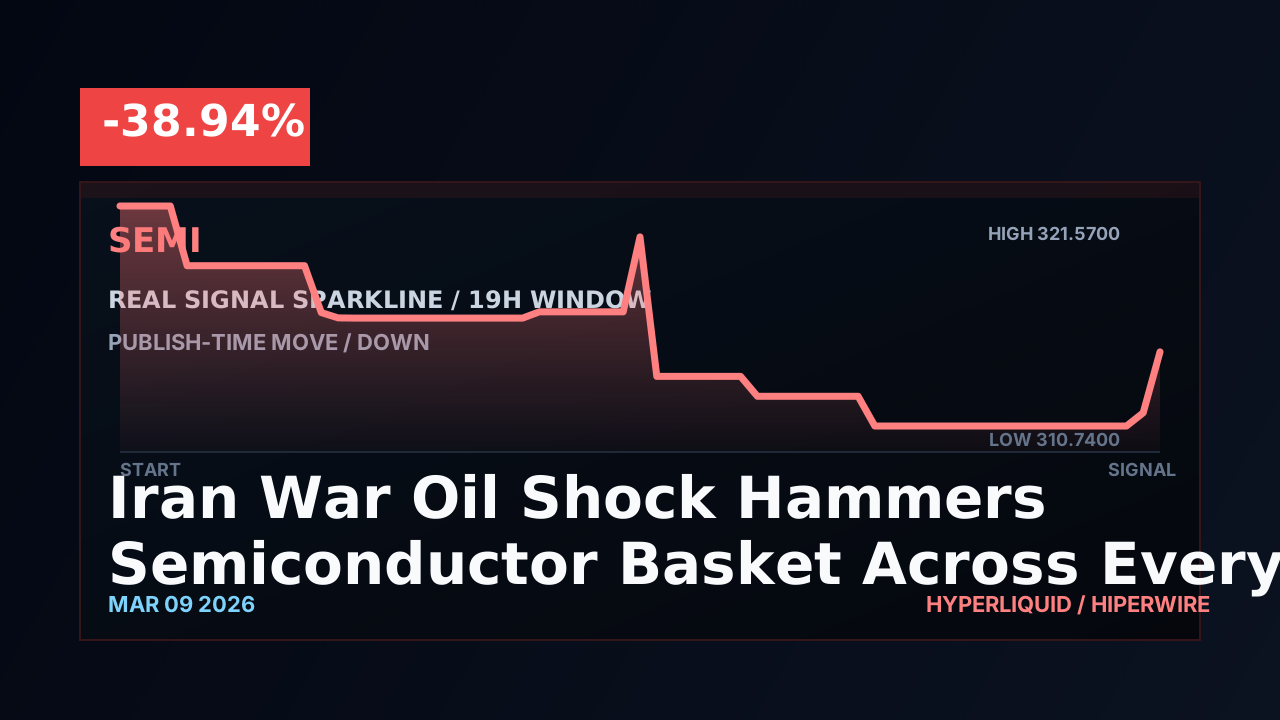
The SEMI basket on Hyperliquid has dropped nearly 39% as the escalating US-Israel-Iran conflict sends oil past $100 a barrel, shuts down the Strait of Hormuz, and triggers the worst KOSPI crash since 2008. Draft AI chip export controls and a dismal US jobs report have compounded the damage, hitting the semiconductor sector from every direction simultaneously.
Mover Brief
The Catalyst: Oil Past $100 and Hormuz Goes Dark
The proximate cause is straightforward: war in the Persian Gulf. As the US-Israel-Iran conflict enters its second week, Tehran has effectively shut down the Strait of Hormuz, suspending roughly a fifth of global crude and natural gas supply. WTI crude opened Sunday futures above $111 and briefly touched $120 — the highest since Russia's invasion of Ukraine — after closing Friday up more than 22% on the week.
For semiconductors specifically, the energy shock is not abstract. Chip fabrication is extraordinarily power-intensive. South Korea, home to Samsung and SK Hynix's memory fabs, is one of the world's largest LNG importers, and its supply chain runs directly through the now-blocked strait. The KOSPI triggered its third program trading sidecar of March on Monday, with Samsung dropping 7.86% and SK Hynix falling 8.01%. The index has now lost over 20% from its February record high.
This is the kind of exogenous shock that reprices an entire sector overnight. A basket of 30 semiconductor names — design, fab, equipment, packaging — has no place to hide when the world's most important energy chokepoint goes offline.
Compounding Blow: AI Chip Export Controls
As if an oil war weren't enough, Bloomberg reported on March 5 that the Trump administration has drafted regulations requiring US government approval for AI chip exports to *any* country. The proposed tiered licensing system would give Washington broad control over whether other countries can build AI training infrastructure — a direct hit to the revenue growth narratives underpinning Nvidia, AMD, and every company in their supply chain.
The rules would require Commerce Department approval for all AI accelerator exports, with larger deployments of 200,000+ GPUs needing certifications from host-country governments. There's internal White House pushback — Trump reportedly views chip exports as bilateral leverage rather than something to restrict — but the market doesn't care about internal memos. The draft exists, and it landed in the worst possible week.
Nvidia closed at $177.89 (-2.94%), AMD at $192.44 (-3.51%), and Intel at $43.42 (-5.51%) heading into the weekend. Monday futures suggest more pain.
Macro Collapse: Jobs Miss and Risk-Off Rotation
Friday's US employment report was brutal. The economy shed 92,000 jobs in February against expectations of a 59,000 gain — a miss of over 150,000 jobs. Manufacturing alone lost 12,000 positions. Unemployment ticked up to 4.4%. This is the kind of print that forces a hard rethink of growth expectations, and semiconductor stocks — priced for an AI supercycle — are acutely vulnerable to that repricing.
The iShares Semiconductor ETF (SOXX) dropped 5.91% on Friday. The VanEck Semiconductor ETF fell 4.21%. These are large single-day moves for broad baskets, and they came *before* Monday's oil surge above $100. The SEMI perp on Hyperliquid, trading 24/7 with up to 15x leverage, has absorbed the full weekend repricing that equity markets haven't opened to yet.
The rotation is textbook: money moving from growth and tech into energy and safe havens. With S&P 500 futures down 1.6% and Nasdaq futures down 2% ahead of Monday's open, the SEMI basket's 39% drawdown on a leveraged perp is directionally consistent with what equity markets are about to price in.
What to Watch
NVIDIA's GTC conference starts March 16. Historically it's been a positive catalyst for the sector, but it's hard to see a keynote about AI infrastructure outweighing a hot war in the Gulf. The conference matters more as a sentiment marker: if Jensen Huang can refocus the narrative on demand rather than supply chain risk, it could put a floor under chip names.
The bigger variable is Hormuz. If shipping remains blocked through mid-March, Goldman Sachs estimates oil could sustain above $100 for months, which would keep the entire cost structure of Asian fab operations under pressure. Samsung and SK Hynix account for the majority of global DRAM and NAND production — their energy costs feed directly into margin compression across the memory supply chain.
For the SEMI basket specifically, $196 is pricing in a significantly worse fundamental outlook than where these stocks closed on Friday. That gap either corrects when US equity markets open, or it's leading indicator. The answer depends almost entirely on what happens in the Strait of Hormuz this week.
Sources & Provenance
Citations below are preserved as structured Postgres source rows for this brief.
Citations Preserved
8
Reference links carried forward from the published mover record.
Original Signal
Open source tweetMarket Route
Direct route preserved for readers who want to inspect the tracked Hyperliquid market behind this archive entry.
Already onboarded? Open tracked market- 1Al Jazeera: Iran war threatens prolonged impact on energy marketsaljazeera.com
- 2Seoul Economic Daily: KOSPI triggers third sidecar, Samsung and SK Hynix plunge 8%en.sedaily.com
- 3Bloomberg: US drafts sweeping AI chip export controlsbloomberg.com
- 4TechCrunch: US considering sweeping new chip export controlstechcrunch.com
- 5Fox Business: US economy shed 92,000 jobs in Februaryfoxbusiness.com
- 6CNBC: Iran war exposes big market concentration riskcnbc.com
- 7Goldman Sachs: How will the Iran conflict impact oil pricesgoldmansachs.com
- 8Charles Schwab: Stocks dive as oil surges, US loses 92,000 jobsschwab.com
This content is for informational purposes only and does not constitute financial advice. Trading perpetual futures involves substantial risk of loss.
Trade SEMI on Hyperliquid
Use referral code HIPERWIRE for 4% off trading fees on your first $25M in volume.
Live Market Metrics
Monitor real-time open interest and funding for SEMI.