Samsung Snaps Back 12% After KOSPI Circuit Breaker Triggers Historic Intraday Low
Samsung Electronics bounced sharply off panic lows on March 9 after the KOSPI plunged over 8% intraday, triggering a circuit breaker for the second time in four sessions. The sell-off, driven by escalating US-Israeli airstrikes on Iran and oil topping $100 a barrel, has wiped roughly 25% off the Korean benchmark since late February. Samsung hit an all-time high of 223,000 KRW just ten days ago on the back of its HBM4 deal with NVIDIA — the speed of the reversal and the violence of the bounce suggest the market is still repricing geopolitical risk in real time.
Mover Brief
The Crash
South Korea's KOSPI has suffered its worst multi-day drawdown since 2001. The index fell 7.2% on March 3, then 12.06% on March 4 — eclipsing the single-day record set after 9/11 — before dropping another 5.96% on Monday March 9, closing at 5,251.87. Trading was halted twice in four sessions via circuit breaker after intraday drops exceeded 8%.
The trigger is crude. Oil topped $100 a barrel as US-Israeli strikes on Iran raised the prospect of a prolonged conflict in the Strait of Hormuz. South Korea imports nearly all of its energy — higher oil prices hit the won, compress margins for manufacturers, and stoke inflation expectations simultaneously. Samsung closed the Monday session down 7.81% from Friday, and SK Hynix shed 9.52%.
The Bounce
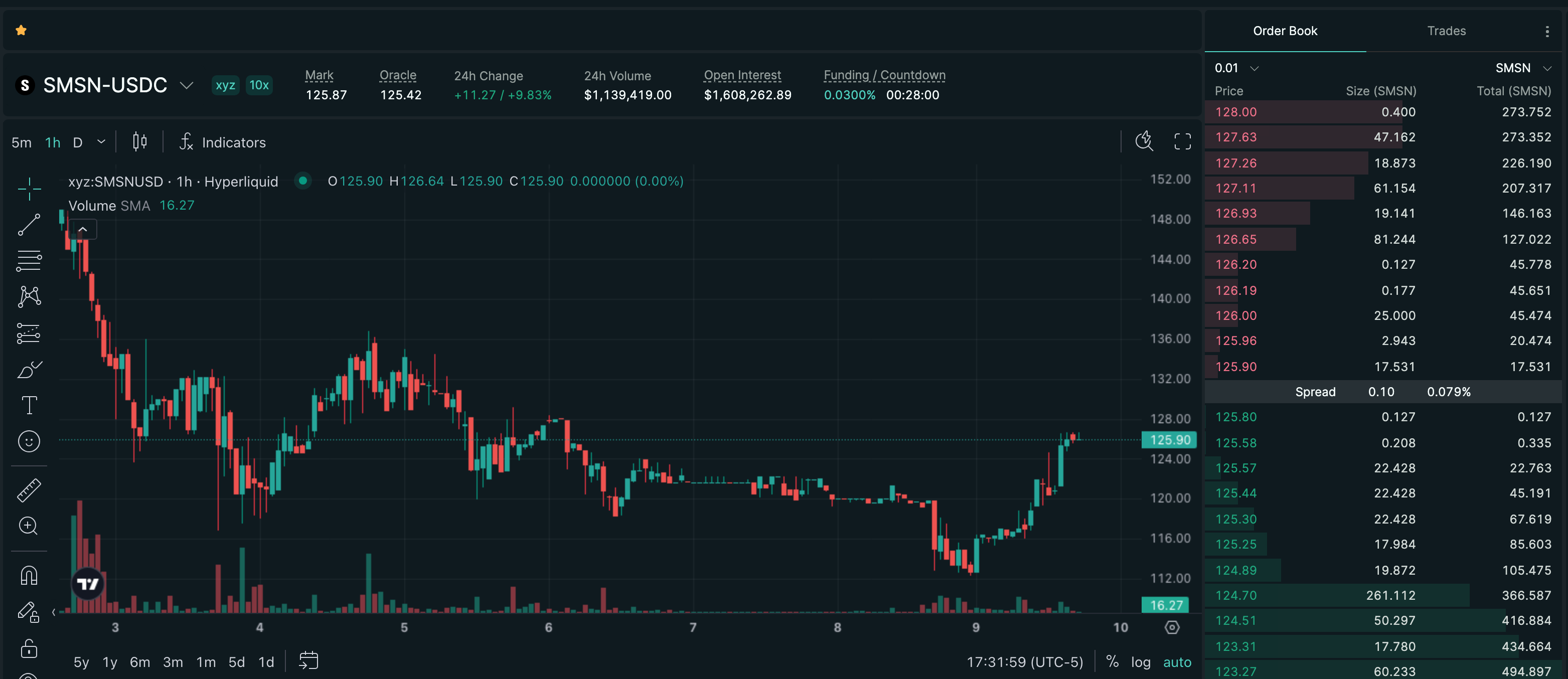
Samsung's 12% rip off intraday lows is a textbook circuit-breaker bounce. When trading resumed after the 20-minute halt on Monday morning, aggressive buyers stepped in on a stock that had fallen from its all-time high of 223,000 KRW on February 27 to roughly 155,000 KRW at the session low — a 30% drawdown in under two weeks. The SMSN perp on Hyperliquid, which tracks Samsung's KRW price converted to USD at the prevailing exchange rate, captured the full bounce in real time while the underlying equity was still halted.
This kind of snap-back is common after forced selling. Korean retail investors hold an outsized share of KOSPI — margin calls and stop-losses cascade into circuit breakers, creating dislocations that institutional and algorithmic capital arbitrage on the reopen. The question is whether this is a dead-cat bounce in a deteriorating macro or the start of a genuine bid.
Why the Fundamentals Still Matter
Ten days ago, Samsung was trading at record highs for good reason. The company posted record quarterly operating profit of 20 trillion won ($13.8 billion) in Q4 2025, up 208% year-over-year, driven by AI memory demand. On February 12, Samsung became the first chipmaker to begin mass production of HBM4, delivering 3.3 TB/s bandwidth per stack — 2.7x faster than HBM3E.
Then on March 8, the Korea Economic Daily reported that NVIDIA selected Samsung and SK Hynix as exclusive HBM4 suppliers for its upcoming Vera Rubin AI accelerator, shutting out Micron entirely. Samsung is expected to supply roughly 30% of NVIDIA's HBM4 allocation, with the Vera Rubin platform set to be formally unveiled at GTC on March 16. The irony of the timing is hard to miss — Samsung secured its most important design win in years on the same weekend the stock was getting crushed by a geopolitical shock entirely unrelated to its business.
What to Watch
The near-term path depends on the conflict. If the Strait of Hormuz remains open and oil pulls back below $90, the KOSPI oversold bounce has room to extend — Samsung's fundamental story has only gotten stronger since the crash began. If strikes escalate and oil pushes toward $120, the won weakens further and Korean equities likely retest the lows regardless of company-specific catalysts.
NVIDIA's GTC keynote on March 16 is the next hard catalyst. A formal Vera Rubin unveil with Samsung prominently featured as an HBM4 partner would give the stock a narrative anchor independent of the macro. Until then, Samsung is trading as a proxy for Korean geopolitical risk, not as the AI memory leader its fundamentals suggest — and that gap is where the opportunity sits for traders willing to size into volatility.
Sources & Provenance
Citations below are preserved as structured Postgres source rows for this brief.
Citations Preserved
7
Reference links carried forward from the published mover record.
Original Signal
Open source tweetMarket Route
Direct route preserved for readers who want to inspect the tracked Hyperliquid market behind this archive entry.
Already onboarded? Open tracked market- 1CNBC — South Korea's Kospi sinks, triggering circuit breaker amid broader Asia market routcnbc.com
- 2Al Jazeera — South Korea's stock market suffers biggest drop in history amid US-Iran waraljazeera.com
- 3Bloomberg — Samsung Posts Record Profit After AI Supercharges Memory Marketbloomberg.com
- 4Dataconomy — Samsung and SK Hynix to Dominate NVIDIA Vera Rubin HBM4 Supplydataconomy.com
- 5VideoCardz — Samsung begins HBM4 mass production and customer shipmentsvideocardz.com
- 6DigiTimes — Samsung nears deal to supply over 30% of Nvidia's HBM4 memorydigitimes.com
- 7Xinhua — S. Korean stocks suffer massive sell-off amid Middle East conflictenglish.news.cn
This content is for informational purposes only and does not constitute financial advice. Trading perpetual futures involves substantial risk of loss.
Trade SMSN on Hyperliquid
Use referral code HIPERWIRE for 4% off trading fees on your first $25M in volume.
Live Market Metrics
Monitor real-time open interest and funding for SMSN.