Samsung Wrecked as Iran War Triggers KOSPI's Worst Day in History
Samsung Electronics plunged 11.7% on March 4 as the KOSPI index suffered its worst single-day crash in history — a 12.06% collapse that eclipsed even the September 11, 2001 selloff. The catalyst: an escalating US-Israeli military campaign against Iran and fears that the Strait of Hormuz, the chokepoint for one-fifth of global oil supply, could shut down entirely. On Hyperliquid, the SMSN perp is down 9.73% over the past 22 hours, currently trading at $123.
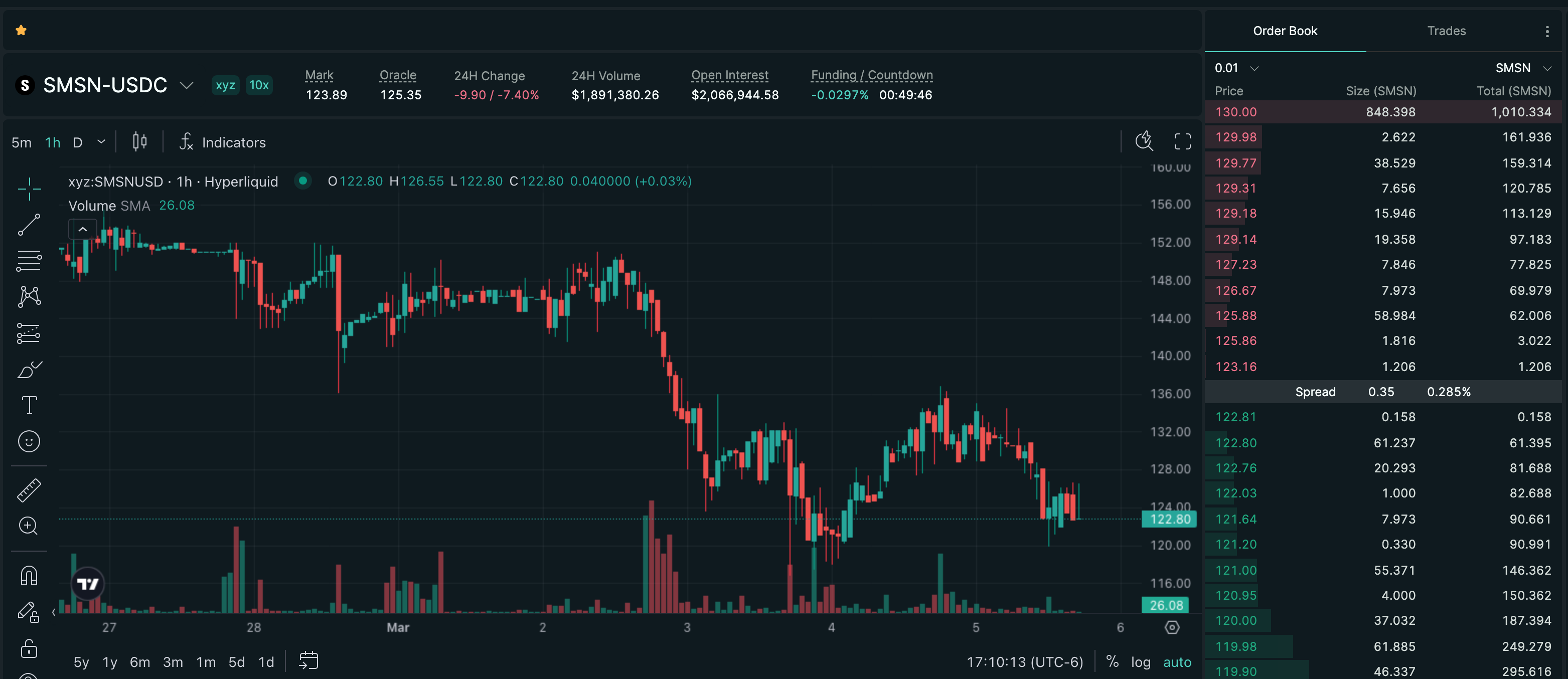
Mover Brief
What Happened
The rout didn't come out of nowhere. On March 3, the KOSPI had already dropped 7.2% as Iran conflict fears first swept through Asian markets. But March 4 was the real bloodbath. The benchmark index cratered 12.06% — a number so extreme that circuit breakers were activated when losses breached the 8% threshold, halting trading for 20 minutes. It didn't matter. Selling resumed immediately when the halt lifted.
The two-day drawdown of roughly 19% wiped over $553 billion in market value from Korean equities. This came after the KOSPI had surged more than 40% in the first two months of 2026, making the reversal even more brutal for latecomers. Samsung Electronics shares closed at 172,200 KRW on March 4 — down 11.74% — on massive volume exceeding 89 million shares. SK Hynix lost roughly 10%, and shipping names like Pan Ocean and HMM were hit even harder, falling 16-17%.
The Korean won simultaneously crashed to 17-year lows against the dollar, compounding losses for dollar-denominated instruments tracking Korean assets — including the SMSN perp on Hyperliquid, whose oracle converts Samsung's KRW price to USD at the prevailing exchange rate.
Why It Moved
South Korea's energy vulnerability is the core story here. The country imports approximately 98% of its fossil fuels, with around 70% of its crude sourced from the Middle East — virtually all of it transiting the Strait of Hormuz. When Iran's Revolutionary Guard declared the strait closed and threatened to target any vessel attempting passage, South Korea's entire energy supply chain came under immediate threat. Oil prices spiked, and markets priced in worst-case scenarios for energy-intensive industries.
Samsung is an indirect victim. As a semiconductor and electronics manufacturer, its operations depend on stable energy supply and functioning global logistics. But the bigger driver was simply indiscriminate panic selling across the entire Korean market. Margin calls cascaded through retail investor accounts — the KOSPI's 40% run-up in early 2026 had attracted enormous leveraged positioning, and the unwind was violent.
Adding to the semiconductor-specific pressure, reports circulated about NVIDIA chip news impacting memory stocks, though the macro panic from Middle East energy disruption clearly dominated price action.
On March 5, Samsung bounced 11.27% to 191,600 KRW as the KOSPI staged its best day since 2008, climbing nearly 10%. President Lee Jae Myung activated a KRW 100 trillion ($68 billion) market stabilization fund, and US Treasury Secretary Bessent announced measures to stabilize oil shipments through the Persian Gulf. Market strategist Daniel Yoo characterized the bounce as "a reversal of leveraged selling" with "nothing to do with fundamentals." The SMSN perp's 9.73% decline over 22 hours likely reflects the lag between the spot crash and thin perp-side liquidity catching up.
What to Watch
The Strait of Hormuz situation remains the single most important variable. If oil shipments normalize, the energy premium priced into Korean assets unwinds further. If Iran escalates or the strait stays effectively closed, the March 4 lows will be tested again.
Monitor the Korean won closely — the SMSN perp is a double exposure, reflecting both Samsung's KRW stock price and the USD/KRW exchange rate. A weakening won amplifies losses even if the stock holds. The $68 billion stabilization fund provides a floor of sorts, but government intervention is a short-term patch, not a structural fix if energy supply remains threatened.
On the company level, Samsung's position in the AI memory boom hasn't changed. The sell-off was geopolitical, not fundamental. But the stock was already facing questions from shareholders about AI chip execution heading into 2026, so any sustained macro weakness could reopen that narrative.
Sources & Provenance
Citations below are preserved as structured Postgres source rows for this brief.
Citations Preserved
12
Reference links carried forward from the published mover record.
Original Signal
Open source tweetMarket Route
Direct route preserved for readers who want to inspect the tracked Hyperliquid market behind this archive entry.
Already onboarded? Open tracked market- 1Al Jazeera: South Korea's stock market suffers biggest drop in historyaljazeera.com
- 2Reuters: Korean stocks dive, won hits 17-year lowreuters.com
- 3CNBC: KOSPI rebounds, best day since 2008cnbc.com
- 4CNBC: KOSPI sinks over 12% as Iran conflict fuels risk-offcnbc.com
- 5Seeking Alpha: Korea's $68B market stabilization fundseekingalpha.com
- 6Disruption Banking: KOSPI plunges 7%, $270B wiped outdisruptionbanking.com
- 7Korea JoongAng Daily: Won rebounds from sharp losseskoreajoongangdaily.joins.com
- 8Yahoo Finance: Samsung Electronics historical pricesfinance.yahoo.com
- 9NewsX: Circuit breakers activated on KOSPInewsx.com
- 10Channels TV: South Korea activates $68B stability fundchannelstv.com
- 11Reuters: Samsung faces shareholder questions on AI chipsreuters.com
- 12Trade SMSN on Hyperliquidapp.hyperliquid.xyz
This article is for informational purposes only and does not constitute financial advice. Trading leveraged perpetual contracts carries substantial risk of loss.
Trade SMSN on Hyperliquid
Use referral code HIPERWIRE for 4% off trading fees on your first $25M in volume.
Live Market Metrics
Monitor real-time open interest and funding for SMSN.