SanDisk Snaps Back After TurboQuant Panic as Analysts Call the Selloff an Overreaction
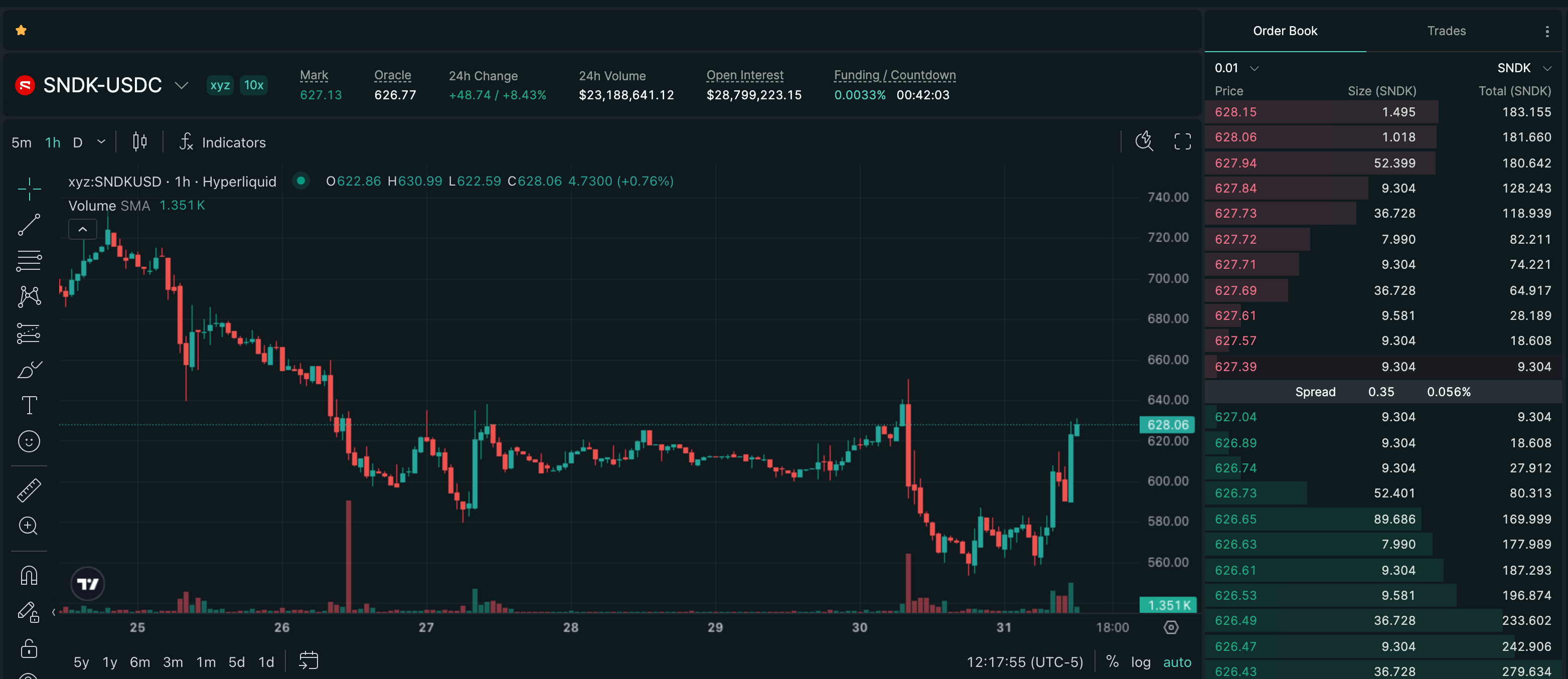
SanDisk recovered 11.83% over 17 hours as the memory sector stabilized following last week's 18.5% drawdown triggered by Google's TurboQuant compression algorithm announcement. Wall Street is closing ranks behind the stock, with Bernstein calling TurboQuant's impact on NAND demand negligible and BofA Securities maintaining a $900 price target. The broader setup remains unchanged: NAND supply for 2026 is sold out and contract prices rose 38% in Q1.
Mover Brief
The TurboQuant Panic and the Snapback
Google published TurboQuant on March 25 — a vector quantization method that shrinks the Key-Value cache used during LLM inference by up to 6x. The market's read was blunt: less memory needed per AI query means less NAND demand. SanDisk dropped 18.5% in five sessions, Micron lost 14%, and Samsung and SK Hynix shed 5-6% each on the Seoul exchange.
The bounce started Monday. SanDisk opened near $560 and pushed back above $620, recovering roughly a third of the drawdown. The catalyst isn't new information — it's the absence of it. TurboQuant is still a lab experiment, not a production deployment. And crucially, it targets inference working memory (KV cache), which lives in DRAM and HBM — not the NAND flash storage that accounts for nearly all of SanDisk's revenue. Bernstein put it plainly: "TurboQuant has zero impact on HDD demand and only minor, indirect impact on NAND demand."
Why the Dip Got Bought
The sell-side piled in fast. BofA Securities maintained its Buy rating with a $900 price target, arguing that TurboQuant could actually *accelerate* edge device deployment — a segment where SanDisk's Edge division already pulled in $1.678 billion in Q2 revenue, up 63% year-over-year. Morgan Stanley reaffirmed Overweight, calling memory supply "a critical bottleneck for AI development" that compression algorithms don't resolve. Bernstein framed all three major storage names — SanDisk, Seagate, and Western Digital — as entry points created by an overreaction.
The financial picture supports that view. SanDisk's Q2 fiscal 2026 numbers were strong: $3.03 billion in revenue (up 61% YoY), $803 million in net income (up 672% YoY), and $980 million in free cash flow. The company guided Q3 revenue to $4.4-4.8 billion with non-GAAP gross margins of 65-67%. Goldman Sachs and Morgan Stanley both have price targets north of $750, and KGI Securities sits at $992.
The NAND Supply Picture Hasn't Changed
The structural backdrop that powered SanDisk's 150% Q1 gain is intact. NAND contract prices rose 38% in Q1 2026, extending a pricing cycle that started in late 2024 when the industry was still absorbing capacity cuts from the 2023-2024 downturn. Samsung is reportedly set to double NAND flash prices in Q2. Multiple manufacturers have indicated that 2026 supply is effectively sold out.
SanDisk is pressing its technology advantage in this environment. The company's BiCS8 218-layer architecture is in volume production, and BiCS10 at 332 layers is slated for late 2026. Its 256TB enterprise SSD — the first of its kind, designed for AI data lakes — launched earlier this year and directly addresses the hyperscaler buildout that creates NAND demand regardless of how efficiently inference runs.
The real question isn't whether TurboQuant reduces KV cache size. It probably does. The question is whether that translates to less total storage purchased by data centers building out retrieval-augmented generation pipelines, vector databases, and multi-petabyte training sets. The Motley Fool flagged the counterargument: cheaper inference could accelerate AI adoption, which would increase — not decrease — the total storage footprint. That Jevons paradox framing is why the dip buyers showed up.
Sources & Provenance
Citations below are preserved as structured Postgres source rows for this brief.
Citations Preserved
6
Reference links carried forward from the published mover record.
Original Signal
Open source tweetMarket Route
Direct route preserved for readers who want to inspect the tracked Hyperliquid market behind this archive entry.
Already onboarded? Open tracked market- 1TechCrunch — Google unveils TurboQuant compression algorithmtechcrunch.com
- 2Yahoo Finance — SanDisk Gains 5%: 3 Reasons the Memory Supercycle Is Far From Overfinance.yahoo.com
- 3Seeking Alpha — Bernstein calls SanDisk, Seagate, WDC entry points after TurboQuant plungeseekingalpha.com
- 4FinancialContent — Deep Dive: SanDisk and the 2026 NAND Flash Shortagemarkets.financialcontent.com
- 5The Motley Fool — Google Just Announced Really Bad News for Micron and SanDiskfool.com
- 6Google Research — TurboQuant: Redefining AI efficiency with extreme compressionresearch.google
This content is for informational purposes only and does not constitute financial advice. Trading perpetual futures involves substantial risk of loss.
Trade SNDK on Hyperliquid
Use referral code HIPERWIRE for 4% off trading fees on your first $25M in volume.
Live Market Metrics
Monitor real-time open interest and funding for SNDK.