SanDisk Adds Bloomberg 500 to Its Index Collection as Memory Demand Stays Maxed Out
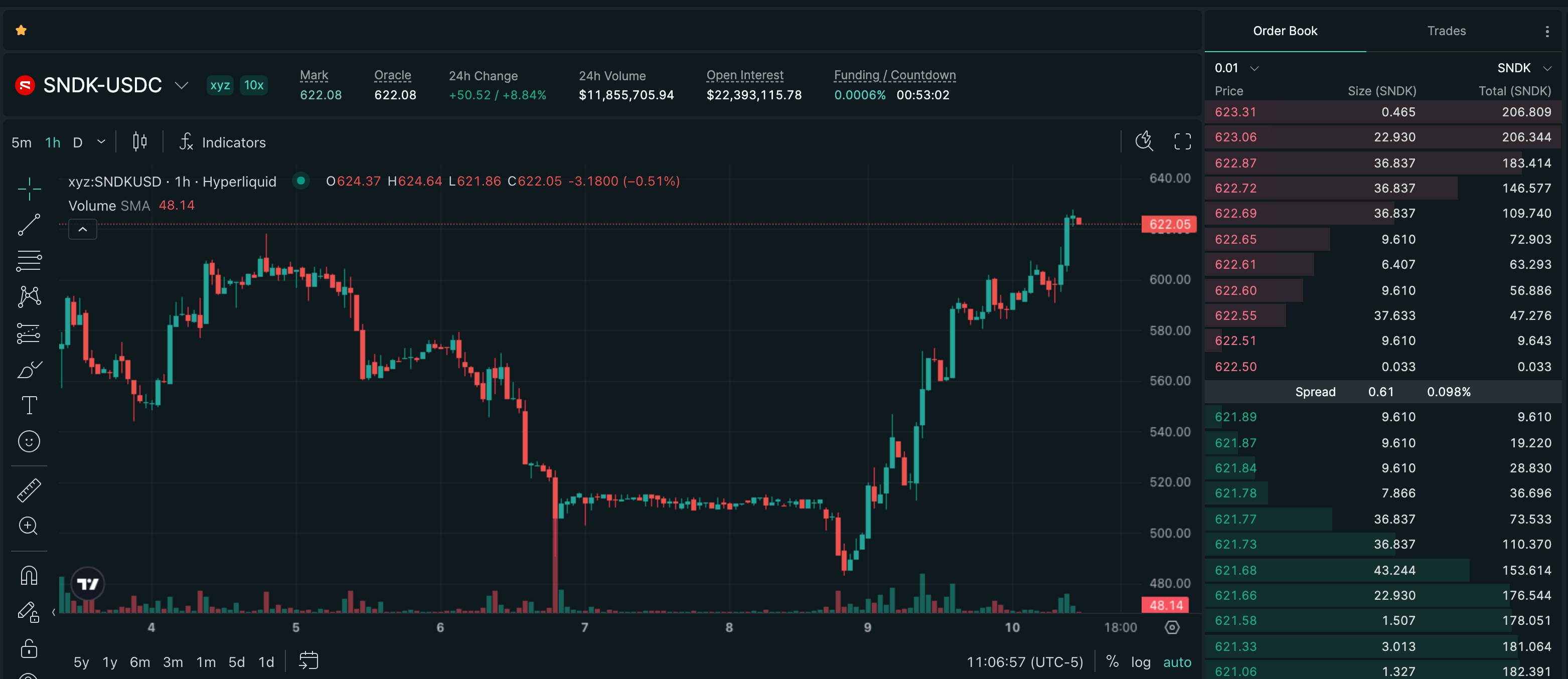
SanDisk ripped more than 10% on the back of its upcoming Bloomberg 500 index inclusion, effective March 12. The addition triggers another round of passive buying for a stock that has already gained over 1,000% since spinning out of Western Digital a year ago, and the timing lands squarely in a quarter where the entire memory sector is bid on structural NAND supply shortages and AI-driven demand.
Mover Brief
The Catalyst: Bloomberg 500 Inclusion
Bloomberg Indices announced on March 5 that SanDisk Corporation (SNDK) would enter the Bloomberg 500 Index effective prior to the open on March 12, 2026. The B500 tracks the 500 most highly capitalized U.S. companies by float market cap, currently reflecting a combined capitalization of $58.19 trillion.
SNDK was one of eleven securities added during the March reconstitution, alongside names like Nebius Group, Coherent Corp, and FTAI Aviation. Index inclusion mechanically forces passive funds benchmarked to the B500 to buy shares, compressing available float — and for a stock with SanDisk's momentum profile, that buying pressure hits a book that's already thin on the offer side.
This is the second major index add in four months. SanDisk joined the S&P 500 in late November 2025, replacing Interpublic Group, less than a year after completing its spin-off from Western Digital. That inclusion triggered a well-documented index effect rally. The Bloomberg 500 add is smaller in scale but lands at a moment when the stock is already in play.
The Overhang Is Clearing
One underappreciated factor in the March move: Western Digital's secondary offering is largely behind the stock now. In mid-February, WDC sold 5.82 million shares of SNDK at $545 each — a $3.17 billion block — through a debt-for-equity exchange with J.P. Morgan and BofA Securities. The deal was part of WDC's plan to fully monetize its spin-off stake and pay down debt.
After the offering, Western Digital retained just 1.69 million shares, which it intends to distribute to its own stockholders or exchange for WDC common stock. That remaining position is small enough that the overhang is effectively gone. For months, the looming secondary had capped enthusiasm on any SNDK rally — traders knew a multi-billion-dollar block was coming. With it absorbed, the stock has room to re-rate without that weight.
Memory Sector in Full Send Mode
SanDisk's move didn't happen in isolation. On March 9, Micron Technology and Western Digital both posted strong gains as the entire memory complex caught a bid. The sector backdrop is straightforward: AI infrastructure buildout has shifted the bottleneck from compute to memory, and supply can't keep up.
Nomura has projected that SanDisk could double data-center storage chip prices in Q1 2026, and the structural shortage isn't expected to ease before 2028. Micron has publicly stated it is sold out of memory for all of 2026. A single Nvidia Rubin R100 superchip now requires up to 288GB of High Bandwidth Memory, and every hyperscaler is scrambling to secure supply.
SanDisk's Q2 FY2026 earnings, reported January 29, underscored the pricing power: revenue hit $3.03 billion (up 61% year-over-year), adjusted EPS came in at $6.20 — 77.65% above consensus — and gross margin expanded to 51.1% from 29.9% the prior quarter. The company projects customer demand to remain well above available supply through at least calendar year 2026.
What Comes Next
Two near-term developments are worth tracking. First, SanDisk and SK hynix formally kicked off global standardization of High Bandwidth Flash (HBF) on February 25 at SanDisk's Milpitas headquarters. HBF targets AI inference workloads and promises comparable bandwidth to HBM at 8-16x the capacity for similar cost. First samples are expected in H2 2026, with AI inference devices incorporating HBF arriving in early 2027. If HBF gains traction as a standard, it opens an entirely new revenue tier for SanDisk beyond traditional NAND.
Second, the analyst community remains firmly bullish. All 14 covering analysts rate SNDK a buy, with price targets ranging from $750 to $1,000. Seeking Alpha recently upgraded the stock with a path-to-$1,000 thesis based on 2027 EPS forecasts. With the stock at $621, that target implies 60% upside — aggressive, but not unreasonable if NAND pricing holds and HBF delivers on its roadmap.
Sources & Provenance
Citations below are preserved as structured Postgres source rows for this brief.
Citations Preserved
6
Reference links carried forward from the published mover record.
Original Signal
Open source tweetMarket Route
Direct route preserved for readers who want to inspect the tracked Hyperliquid market behind this archive entry.
Already onboarded? Open tracked market- 1Bloomberg 500 Index March 2026 Reconstitution (PR Newswire)prnewswire.com
- 2SanDisk Q2 FY2026 Earnings Releaseinvestor.sandisk.com
- 3SanDisk Secondary Offering Pricing (Investor Relations)investor.sandisk.com
- 4SanDisk and SK hynix HBF Standardization Announcementsandisk.com
- 5SanDisk S&P 500 Inclusion (CNBC)cnbc.com
- 6SNDK, MU, WDC Rally Coverage (24/7 Wall St.)247wallst.com
This content is for informational purposes only and does not constitute financial advice. Trading perpetual futures involves substantial risk of loss.
Trade SNDK on Hyperliquid
Use referral code HIPERWIRE for 4% off trading fees on your first $25M in volume.
Live Market Metrics
Monitor real-time open interest and funding for SNDK.