SPCX Adds 14.25% as $30B of Forced Index Buying Bears Down on a 3% Float
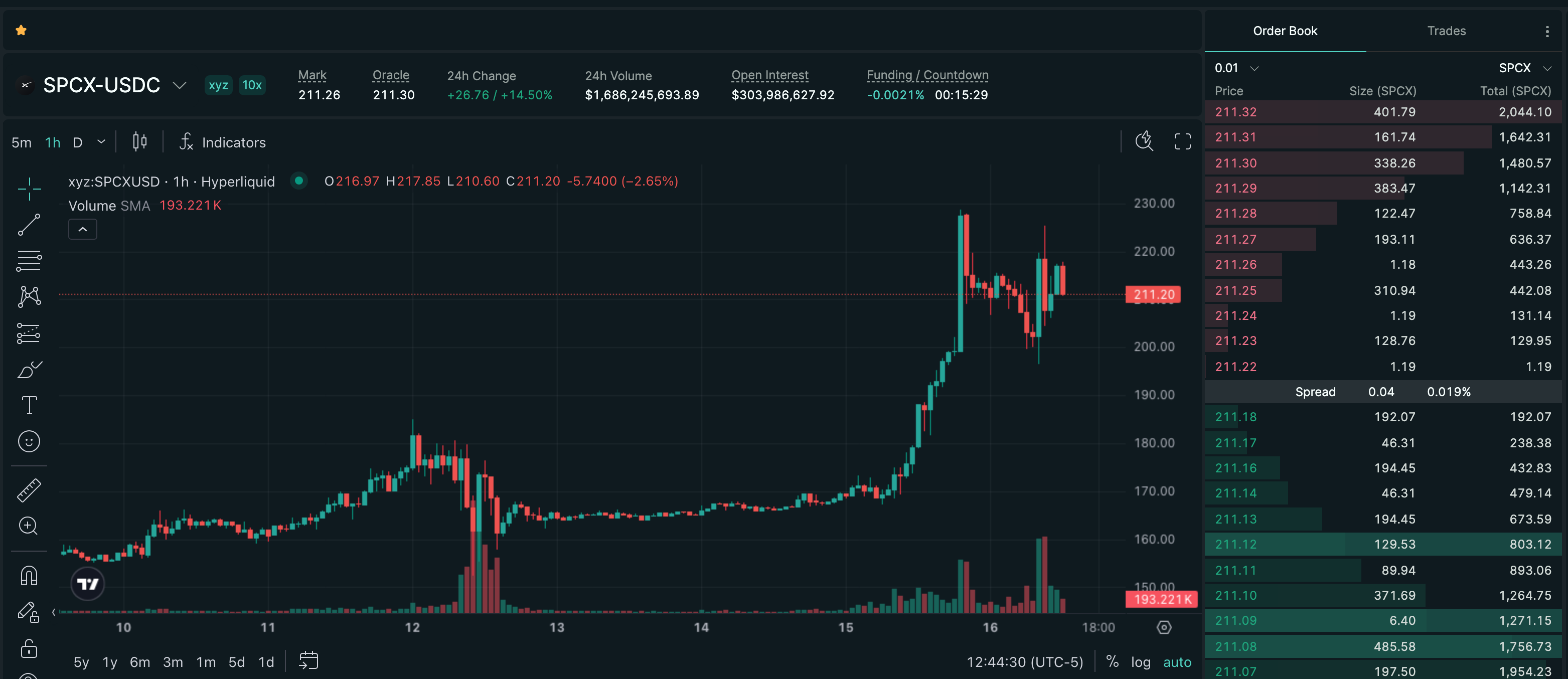
SpaceX priced the largest IPO in history at $135 a share on June 12, and four sessions later SPCX trades near $210.90 — up about 56% with no sign of slowing. The driver isn't one headline. Nasdaq rewrote its rules to fast-track the stock into the Nasdaq-100 in 15 trading days, setting up as much as $30 billion in forced index buying against a public float of only 3-4%. Listed options just went live and SpaceX is using its own inflated stock to buy Cursor for $60 billion — every layer points the same direction into a supply that barely exists.
Mover Brief
Four Sessions, One Continuous Repricing
SpaceX priced its IPO at $135 a share on June 12, raising more than $75 billion in the largest stock-market debut on record. It closed the first session around $161, up roughly 19%, and by the next full day was up more than 35% from the offer price. Four sessions in, SPCX changes hands near $210.90 — about 56% above the IPO price.
This isn't a single-catalyst pop. It's a continuous repricing of a name the market still hasn't figured out how to value, and every fresh print is the crowd trying to get ahead of what comes next. The +14.25% over the last 24 hours is continuation, not a new story breaking — which is exactly why the structural setup underneath matters more than any one headline.
The Index Funds Have to Buy
The dominant force here isn't a press release — it's mechanics. Nasdaq rewrote its own eligibility rules so SPCX can enter the Nasdaq-100 after just 15 trading days, down from the usual three-month minimum. BNP Paribas estimates Nasdaq-100 inclusion alone forces roughly $8 billion of passive buying in the first month, with total index-fund demand potentially near $30 billion.
The problem for anyone fading this: only about 3-4% of shares are freely tradable, with founder stock locked up for 366 days, and passive funds could end up holding around 30% of the free float within those 15 trading days. Funds tracking QQQ and the Russell 1000 will have to sell Apple, Microsoft, and Nvidia to buy this one low-float newcomer. The S&P 500 declined to fast-track inclusion, but CRSP-tracked funds like VTI and VUG are already on the inclusion calendar. That's a structural bid landing on a supply that barely exists — the cleanest explanation for why dips keep getting bought.
Reflexivity Stacked on Top
Two developments turned a forced-buying setup into a reflexive one. First, listed options on SPCX went live this week, dropping dealer hedging flows onto a name whose float is already too thin to absorb them — short-gamma dealers amplify moves rather than fade them.
Second, SpaceX agreed to buy Cursor parent Anysphere for $60 billion entirely in its own stock, structuring the deal through a subsidiary so that IPO proceeds aren't touched. Paying with equity that's up ~56% in a week means SpaceX is funding its biggest AI bet with the most expensive currency it will ever print — and because the deal is all-stock, it welds the xAI and AI-coding narrative directly onto the share price that narrative is inflating. The reflexivity is the whole game: the higher the stock goes, the cheaper the acquisition looks, the bigger the AI story gets, the more buyers it pulls in.
What Breaks the Trade
The same thin float that powers the move up is the risk. At $210.90 the stock carries a roughly $2 trillion-plus valuation while the average 12-month analyst target sits near $164 — the price is already running well ahead of where the sell side thinks fundamentals land. Once the forced index bid is in the tape, the marginal buyer has to become a discretionary one, and that's the moment a 3-4% float cuts both ways.
The specific things that matter from here: the actual late-June index-add dates (a textbook buy-the-rumor, sell-the-news risk), whether real demand shows up after passive funds finish loading, and the 366-day lockup that eventually returns founder supply to the market. None of it is imminent. All of it is what turns a structural bid into an air pocket.
Sources & Provenance
Citations below are preserved as structured Postgres source rows for this brief.
Citations Preserved
8
Reference links carried forward from the published mover record.
Original Signal
Open source tweetMarket Route
Direct route preserved for readers who want to inspect the tracked Hyperliquid market behind this archive entry.
Already onboarded? Open tracked market- 1Reuters — SpaceX prices record $75B IPO at $135 a sharereuters.com
- 2CNBC — SpaceX closes first day at ~$161 after record debutcnbc.com
- 3Yahoo Finance — SPCX up over 35% from debut by second dayfinance.yahoo.com
- 4TradingKey — Index funds to take ~30% of float within 15 days of listingtradingkey.com
- 5SpotGamma — Index rule changes force SPY/QQQ/IWM funds to buy SPCXspotgamma.com
- 6etf.com — Every ETF that will hold SPCX, and whenetf.com
- 7TechCrunch — SpaceX to acquire Cursor for $60B in all-stock dealtechcrunch.com
- 8Investing.com — SPCX price and analyst price targetsinvesting.com
This content is for informational purposes only and does not constitute financial advice. Trading perpetual futures involves substantial risk of loss.
Trade SPCX on Hyperliquid
Use referral code HIPERWIRE for 4% off trading fees on your first $25M in volume.
Live Market Metrics
Monitor real-time open interest and funding for SPCX.