SPCX Options Go Live Into a 3-5% Float as Price Laps the Analyst Targets
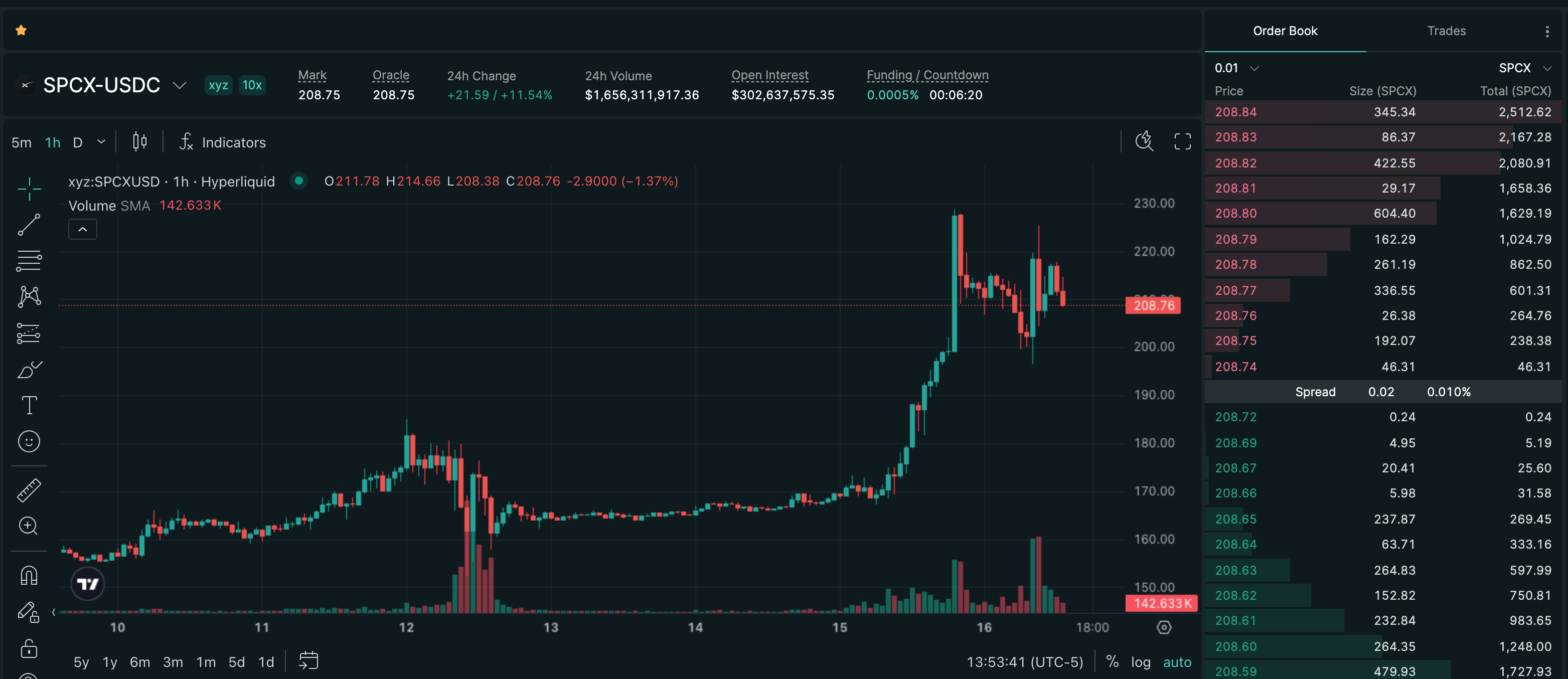
SpaceX's tracker stock added 11.52% over 24 hours to $208.70, roughly 55% above its $135 IPO price since the June 12 debut. The proximate catalyst is mechanical, not fundamental: listed options begin trading on June 16, layering a fresh dealer-gamma bid onto a public float of just 3-5%, with tens of billions in forced Nasdaq-100 buying still queued for the weeks ahead. That structural demand has carried SPCX to a market cap above $2 trillion and roughly 27% past the average analyst target near $164, even as fundamental valuations peg fair value far lower. The real question isn't whether the bid is real — it's what holds the stock up once the plumbing stops buying.
Mover Brief
The Catalyst: Options Arrive Mid-Run
SPCX is up 11.52% over 24 hours to $208.70, and the event defining the session is the start of listed options trading on June 16. That matters more than it would on a normal large-cap. Options introduce a new set of forced buyers and sellers — market makers who hedge their books by trading the underlying — and they're arriving on a stock whose public float is only 3% to 5% of a $2 trillion company.
When dealers are short gamma into a thin, fast-moving name, hedging flows tend to chase price in both directions and amplify the existing trend. GuruFocus flagged that the options market was expected to see heavy activity as traders position for volatility. In practice, options day stacks one more mechanical bid on top of an order book that was already too small for the demand chasing it.
A Structural Bid, Not a Re-Rate
Strip away the headline and almost none of this move is the market deciding SpaceX is suddenly worth more. It's plumbing. Nasdaq rewrote its own rules to fast-track SPCX into the Nasdaq-100 after just 15 trading days, pointing inclusion at late June or early July. SpotGamma estimates roughly $22-27 billion of mechanical buying from Nasdaq-100 and Russell 1000 trackers — some bank desks have pegged total passive demand even higher — landing into that 3-5% float over a matter of weeks.
The contrast with the S&P is the tell. S&P reaffirmed its existing rules and blocked SpaceX from early entry into its benchmarks, while Nasdaq accommodated. The buyers queued up behind that decision are price-agnostic by design: they buy because the index says to, not because the stock is cheap. Every ETF that has to hold SPCX is buying on a known timeline, and traders are front-running it.
Where the Fundamentals Actually Sit
At $208.70, SPCX carries a market cap above $2 trillion, making SpaceX one of the largest companies in the US on a stock that has existed for days. The price-to-sales multiple sits around 73x, and the analyst community is openly split. Oppenheimer is reported around a $190 Outperform target and NewStreet near $165, while Morningstar values the core business closer to a $63-75 fair value and CFRA's Keith Snyder has publicly questioned the IPO valuation. The average target sits near $164 — meaning the stock is trading roughly 27% above where the sell-side, on balance, thinks it belongs.
The business underneath is real and growing: Starlink posted about $1.19 billion in operating profit in Q1 2026 across roughly 10.3 million subscribers, and 2025 revenue of $18.67 billion was up 33% year over year. SpaceX is also folding in Anysphere, the maker of Cursor, in a $60 billion stock-funded deal. But none of that explains a 55% gain since the June 12 debut. The structural bid has outrun even the bullish fundamental case.
What to Watch
The next scheduled forced-buying event is the Nasdaq-100 inclusion itself, expected in late June or early July; that's when passive trackers actually have to own the stock rather than just front-runners anticipating them. Watch where options open interest and dealer positioning build now that contracts trade — on a 3-5% float, gamma can dictate intraday range more than any fundamental headline.
The same scarcity that powered the run cuts the other way. After a roughly 55% gain in a handful of sessions, a thin float means thin liquidity on the exit, and the stock has already lapped the average analyst target. The entire trade is the distance between the structural bid near $208 and a fundamental floor some analysts put in the $63-75 range. As long as the index and options plumbing keeps buying, the gap holds; the risk is what happens to a name this richly priced once the mechanical demand is filled.
Sources & Provenance
Citations below are preserved as structured Postgres source rows for this brief.
Citations Preserved
7
Reference links carried forward from the published mover record.
Original Signal
Open source tweetMarket Route
Direct route preserved for readers who want to inspect the tracked Hyperliquid market behind this archive entry.
Already onboarded? Open tracked market- 1CNBC — SpaceX IPO debut: SPCX closes at $161, up 19% in record listingcnbc.com
- 2Reuters — SpaceX targets $75B IPO at $135 per sharereuters.com
- 3Alpaca — SPCX options trading availability (June 16 launch)docs.alpaca.markets
- 4SpotGamma — SpaceX index inclusion mechanics and forced buying estimatespotgamma.com
- 5etf.com — Every ETF that will hold SPCX, and whenetf.com
- 6CNBC — SpaceX blocked from early S&P benchmark entrycnbc.com
- 7GuruFocus — SPCX surges past $2T valuation; analyst targets divergegurufocus.com
This content is for informational purposes only and does not constitute financial advice. Trading perpetual futures involves substantial risk of loss.
Trade SPCX on Hyperliquid
Use referral code HIPERWIRE for 4% off trading fees on your first $25M in volume.
Live Market Metrics
Monitor real-time open interest and funding for SPCX.