WTI Dumps 9% as First Tankers Push Through the Strait of Hormuz
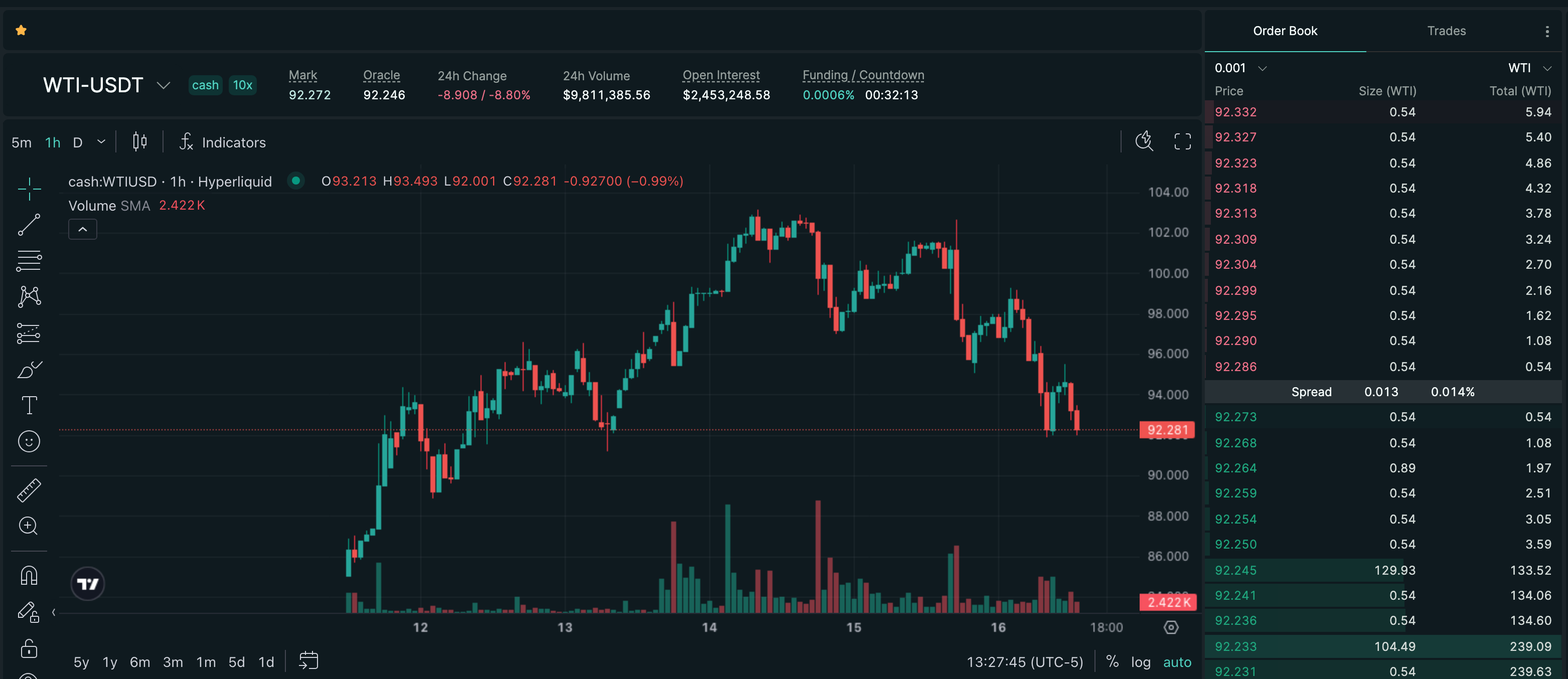
WTI crude fell from above $102 to $92 on March 16 after the first concrete signs that Strait of Hormuz traffic is resuming. Treasury Secretary Bessent confirmed the U.S. is allowing Iranian tankers through, and the first non-Iranian cargo ship transited the strait on March 15 with its AIS beacon on for the first time since the war began. The selloff layers on top of the IEA's record 400 million barrel strategic reserve release and Trump's push for an allied coalition to escort commercial shipping through the chokepoint.
Mover Brief
The De-Escalation Trade
WTI traded above $102 overnight before reversing hard on Monday, settling around $95 on CME and dropping as low as $92 on 24/7 perp markets. The trigger was a cluster of signals that the Strait of Hormuz — shut to commercial traffic since the U.S.-Israeli strikes on February 28 — might be reopening.
Treasury Secretary Scott Bessent told CNBC that the U.S. is allowing Iranian oil tankers to transit the strait: "The Iranian ships have been getting out already, and we've let that happen to supply the rest of the world." More importantly, the first non-Iranian cargo ship safely crossed the strait on March 15 with its Automatic Identification System switched on — a meaningful milestone after 16 commercial vessels had been attacked since the war began.
The S&P 500 jumped 1% on the oil reversal, its best day since the Iran war started. Airlines, cruise lines, and fuel-intensive sectors led the rally.
Trump's Hormuz Coalition — and Who Said No
Trump is assembling a coalition to escort commercial tankers through the strait, calling on China, Japan, France, and the UK by name. He warned NATO would face a "very bad" future if they declined to help. A Wall Street Journal report indicated the U.S. planned to announce the coalition this week.
The response so far has been cold. Japan and Australia both said Monday they have no plans to send naval vessels. The strait normally handles roughly 138 ship transits per day; it's currently averaging fewer than five. That gap between diplomatic intention and physical reality is why oil is still $92 and not $70.
Energy Secretary Wright projected the conflict could resolve within "the next few weeks," but Israel outlined plans for at least three more weeks of operations. The market is pricing in hope, not resolution.
The Supply Stack: IEA Release Meets Strait Math
Sitting underneath the headline geopolitics is the IEA's record 400 million barrel strategic reserve release, announced March 11. The U.S. will contribute 172 million barrels from the SPR, with G7 nations covering 70% of the total.
The numbers sound large but the math is simple. The release will deliver at roughly 1.4 million barrels per day over 120 days. The Strait of Hormuz normally moves over 20 million barrels per day. The IEA itself called this "the largest disruption to global energy supplies in history."
Gasoline has already hit $3.72 per gallon nationally, up 80 cents from a month ago, with diesel near $5. The reserve release keeps a floor under how bad the shortage gets, but it doesn't fix it. Only tankers moving through Hormuz at scale does that — and today's five-per-day pace is a rounding error against 138.
What to Watch
The binary question is whether coalition escorts materialize this week. If the U.S. announces a credible multi-nation naval escort and commercial shipping resumes at meaningful volume, WTI could retrace toward $80 quickly — the pre-war baseline was around $70.
If the coalition stalls and Iran continues attacking commercial vessels, this selloff is a dead cat bounce in a supply crisis. The previous pattern has been clear: every de-escalation signal since February 28 has been faded within 48 hours as physical disruption reasserted itself. WTI plunged 24% on March 9 on similar hopes, then snapped right back above $100.
The Hyperliquid perp market at $92.22 is already pricing a steeper move than CME's $95 close, reflecting the 24/7 market's faster digestion of overnight headlines. That premium has been a useful tell throughout this conflict — it led the bounce on March 11 by hours.
Sources & Provenance
Citations below are preserved as structured Postgres source rows for this brief.
Citations Preserved
7
Reference links carried forward from the published mover record.
Original Signal
Open source tweetMarket Route
Direct route preserved for readers who want to inspect the tracked Hyperliquid market behind this archive entry.
Already onboarded? Open tracked market- 1BNN Bloomberg — Falling oil prices send Wall Street toward best day since Iran warbnnbloomberg.ca
- 2CNBC — U.S. allowing Iranian tankers through Strait of Hormuz, Bessent sayscnbc.com
- 3Al Jazeera — Oil prices as Trump seeks coalition to reopen Strait of Hormuzaljazeera.com
- 4GV Wire — Oil prices ease as some ships sail through Straitgvwire.com
- 5IEA — Largest ever oil stock release announcementiea.org
- 6NBC News — IEA 400 million barrel release detailsnbcnews.com
- 7NPR — Gasoline prices day 17 of Iran warnpr.org
This content is for informational purposes only and does not constitute financial advice. Trading perpetual futures involves substantial risk of loss.
Trade WTI on Hyperliquid
Use referral code HIPERWIRE for 4% off trading fees on your first $25M in volume.
Live Market Metrics
Monitor real-time open interest and funding for WTI.