WTI Reclaims $103 After Islamabad Talks Collapse and Trump Orders Hormuz Blockade
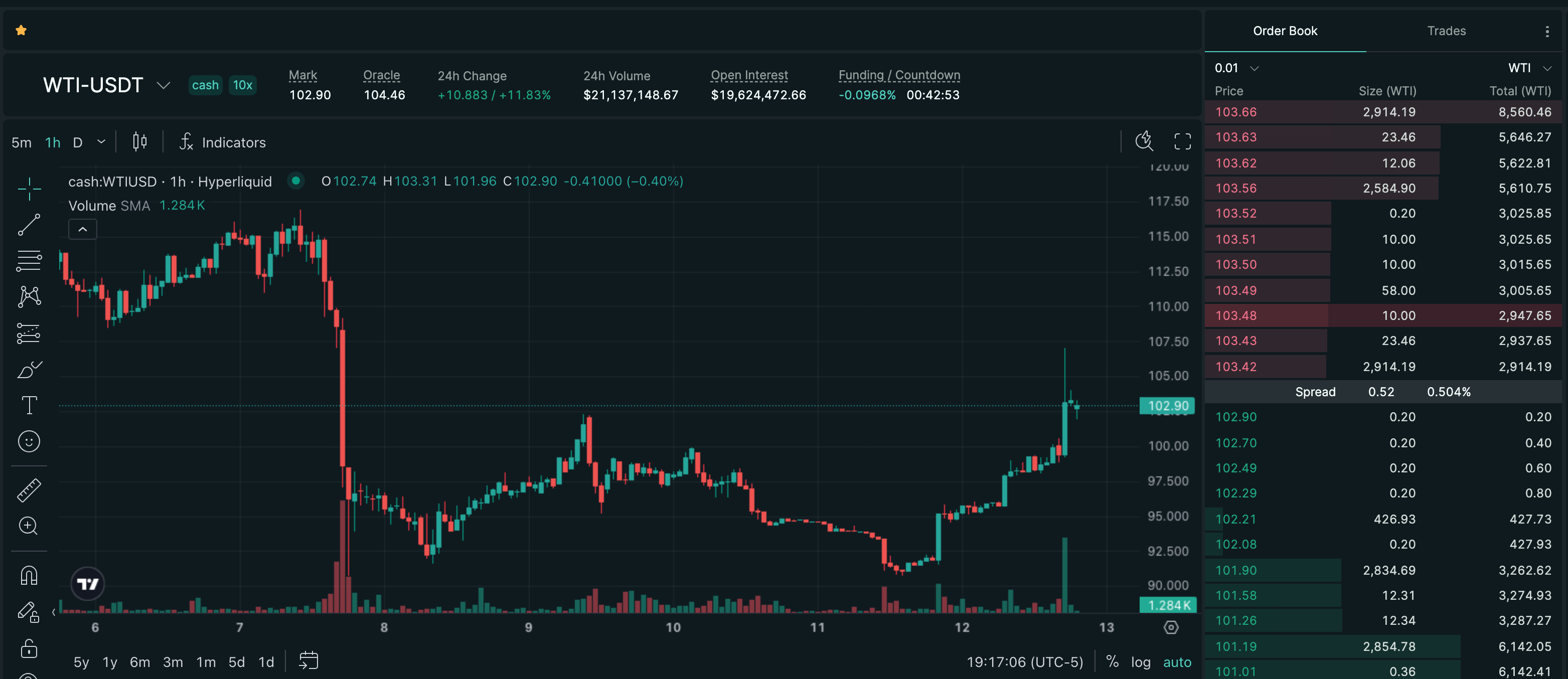
WTI crude rebounded 12.6% from post-ceasefire lows after 21 hours of US-Iran peace talks in Islamabad ended without a deal. Trump responded within hours by declaring a full naval blockade of the Strait of Hormuz, ordering the US Navy to interdict all vessels entering or leaving the waterway. The move effectively reprices the strait as closed for the foreseeable future, unwinding the brief ceasefire discount that had dragged crude below $95 earlier in the week.
Mover Brief
The Islamabad Collapse
The two-week ceasefire that crashed WTI 16% on April 8 was supposed to create space for a deal. Instead, the first face-to-face US-Iran talks since the war began produced nothing.
VP Vance led the US delegation into 21 hours of marathon negotiations in Islamabad, mediated by Pakistan. He emerged Sunday saying he was "unable to reach an agreement" and that Iran had "chosen not to accept our terms." The core impasse: the US demanded Iran commit to abandoning not just nuclear weapons but any enrichment capability, including for medical purposes. Tehran refused.
Iran's demands were equally non-negotiable — control of the Strait of Hormuz, release of $6 billion in frozen assets, war reparations, and a regional ceasefire that included Lebanon. The US and Israel rejected the Lebanon linkage outright. Iranian Foreign Ministry spokesman Esmaeil Baghaei tried to downplay the failure, saying "no one had such an expectation" of a single-session deal, but the market read it differently.
The Blockade
Trump's response came fast. Hours after Vance's announcement, Trump declared on social media that the US Navy would "begin the process of BLOCKADING any and all Ships trying to enter, or leave, the Strait of Hormuz" and would "seek and interdict every vessel in International Waters that has paid a toll to Iran."
This is not just rhetorical escalation. The US Navy had already sent destroyers into the strait for the first time since the war began on April 11 and initiated mine-clearing operations. Iran reportedly lost track of mines it had planted, leaving even Tehran unable to fully guarantee safe passage.
Retired Admiral James Stavridis estimated the operation would require two carrier strike groups, a dozen destroyers and frigates outside the Gulf, and another half-dozen warships plus Saudi and UAE naval assets inside it. He called it "a big task, and it's a big gamble," noting that the strait is effectively an Iranian "kill box" filled with anti-ship missiles, drones, fast-attack boats, and mines.
The UK immediately declined to participate. Senator Mark Warner questioned the logic: "I don't understand how blockading the strait is somehow going to push the Iranians into opening it."
The Supply Picture
The numbers tell the story. Between Wednesday and Friday, only 22 vessels transited the Strait of Hormuz — against a pre-war baseline of roughly 135 per day. The strait handles about 20% of the world's seaborne oil and LNG, approximately 20 million barrels per day. A formal blockade makes that trickle functionally zero.
There is one bright spot on the supply side. Saudi Arabia restored its East-West pipeline to full capacity at 7 million bpd on Sunday, recovering from attacks that had cut throughput by 700,000 bpd. The Manifa oilfield is also back at 300,000 bpd, though Khurais is still under repair after losing 300,000 bpd of capacity. That pipeline bypasses Hormuz entirely, routing crude to the Red Sea port of Yanbu — it is now the primary relief valve for Gulf oil reaching global markets.
But 7 million bpd through a pipeline does not replace 20 million bpd through a strait. The Dallas Fed estimated a sustained Hormuz closure would raise WTI to $98 average in Q2 and cut global GDP growth by 2.9 annualized percentage points. Wall Street analysts are now floating $200 scenarios if the blockade holds through summer. WTI at $103 may be pricing in a resolution that just became much harder to reach.
Sources & Provenance
Citations below are preserved as structured Postgres source rows for this brief.
Citations Preserved
7
Reference links carried forward from the published mover record.
Original Signal
Open source tweetMarket Route
Direct route preserved for readers who want to inspect the tracked Hyperliquid market behind this archive entry.
Already onboarded? Open tracked market- 1Al Jazeera — Trump Announces Hormuz Blockade After Peace Talks Endaljazeera.com
- 2Al Jazeera — US and Iran Fail to Reach Deal After Marathon Islamabad Talksaljazeera.com
- 3Fortune — How a US Naval Blockade of the Strait of Hormuz Could Workfortune.com
- 4NPR — No Deal: US-Iran Peace Talks in Islamabad Collapsenpr.org
- 5Al Jazeera — Saudi East-West Pipeline Restored to Full Capacityaljazeera.com
- 6Dallas Fed — What the Closure of the Strait of Hormuz Means for the Global Economydallasfed.org
- 7Wikipedia — 2026 Strait of Hormuz Crisisen.wikipedia.org
This content is for informational purposes only and does not constitute financial advice. Trading perpetual futures involves substantial risk of loss.
Trade WTI on Hyperliquid
Use referral code HIPERWIRE for 4% off trading fees on your first $25M in volume.
Live Market Metrics
Monitor real-time open interest and funding for WTI.