WTI Snaps Back as Tanker Attacks Overwhelm Record IEA Reserve Release
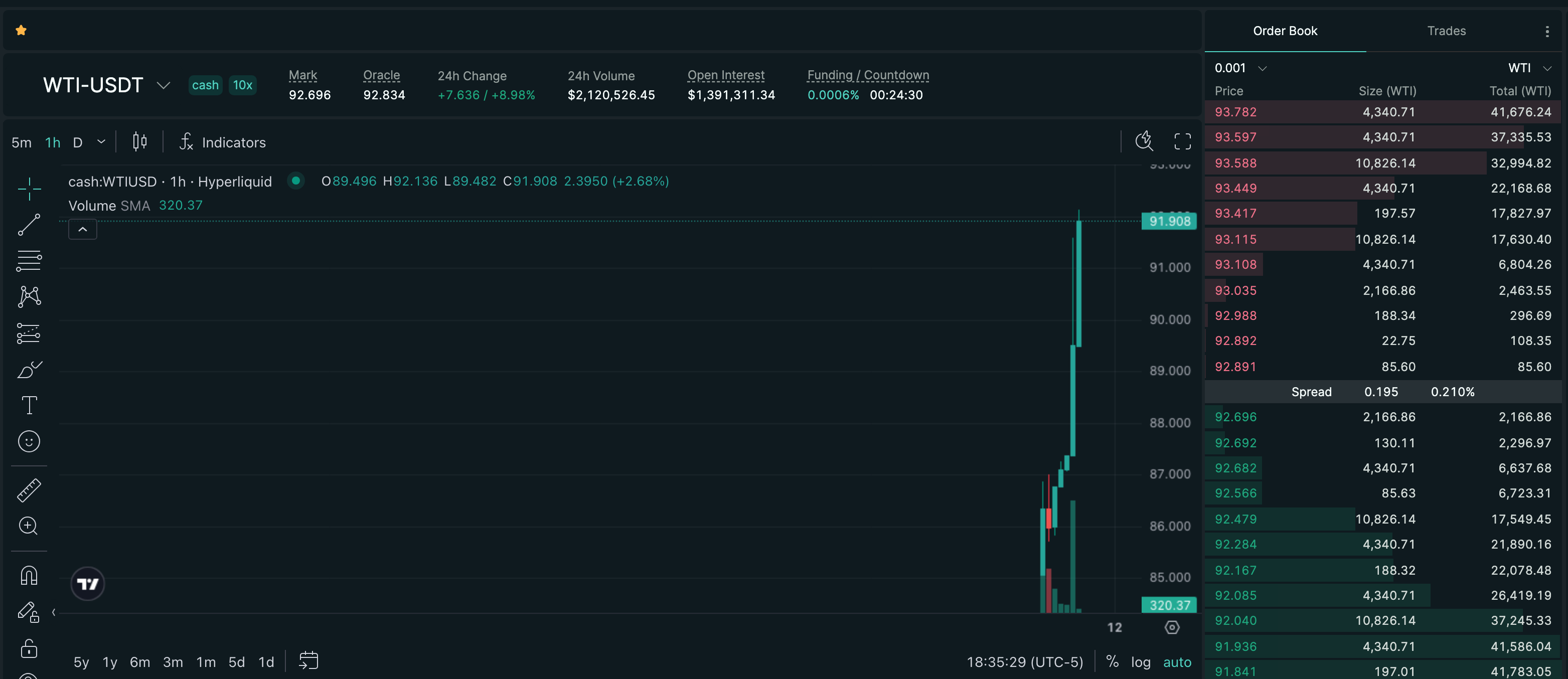
WTI crude bounced 7.6% in five hours on March 11, erasing much of the prior session's 11% collapse. Fresh attacks on commercial vessels near the Strait of Hormuz reminded the market that the IEA's historic 400 million barrel reserve release is arithmetic noise against 16 million barrels per day of blocked supply.
Mover Brief
The Bounce
WTI had its worst single-session drop of the entire Iran conflict on March 10, falling 11% as traders took profits after a 35% weekly gain — the largest in the history of crude futures dating back to 1983. That selloff lasted roughly 24 hours.
On March 11, at least three commercial vessels were hit with projectiles off Iran's coast, and WTI immediately reversed. CME WTI settled up 4.55% at $87.25, while the 24/7 perp market continued climbing to $92.84 — a $5+ premium reflecting overnight risk that traditional markets can't price until the next session open.
The intraday pattern was telling: prices briefly dipped on the IEA reserve announcement, then ripped higher as the tanker news sank in. The market is treating supply disruption as the dominant force and reserve releases as a temporary salve.
Why 400 Million Barrels Isn't Enough
The IEA announced its largest-ever emergency release on March 11: 400 million barrels from the strategic reserves of its 32 member countries. The U.S. will contribute 172 million barrels from the SPR, with G7 nations accounting for 70% of the total pledge.
The numbers look large in isolation. They aren't. The release will take approximately 120 days to deliver, and JPMorgan estimates the peak discharge rate at around 1.4 million barrels per day. The Strait of Hormuz normally handles over 20 million barrels per day, with roughly 15 million barrels of crude and 5 million barrels of refined products currently blocked. That's an 11-to-1 mismatch between the disruption and the fix.
As IEA Executive Director Fatih Birol put it: "The most important thing for a return to stable flows of oil and gas is the resumption of transit through the Strait of Hormuz." The reserves buy time. They don't solve the problem.
The Strait Stays Shut
The Strait of Hormuz has been effectively closed to commercial tanker traffic since February 28, when U.S.-Israeli strikes killed Ayatollah Khamenei and triggered an Iranian military response. Insurers, oil companies, and cargo firms have all pulled back. Current crude export volumes through the strait are less than 10% of pre-conflict levels.
The downstream effects are compounding. Iraqi production from its three main southern oilfields has collapsed 70% — from 4.3 million barrels per day to 1.3 million — because the crude has nowhere to go. Gulf Arab states are cutting production as onshore storage fills up. The disruption has now lasted longer than the Suez Crisis of 1956-57, which had previously been the worst supply shock on record.
WTI is up more than 30% since the conflict started. Retail gasoline has jumped over 50 cents to $3.57 per gallon. Until ships move through Hormuz again, the supply math doesn't change — and neither does the direction of oil prices.
Sources & Provenance
Citations below are preserved as structured Postgres source rows for this brief.
Citations Preserved
6
Reference links carried forward from the published mover record.
Original Signal
Open source tweetMarket Route
Direct route preserved for readers who want to inspect the tracked Hyperliquid market behind this archive entry.
Already onboarded? Open tracked market- 1CNBC — Crude prices close higher weighing tanker threats against IEA releasecnbc.com
- 2PBS — IEA agrees to release record volume of emergency oil reservespbs.org
- 3NBC News — IEA 400 million barrel release fails to bring down pricesnbcnews.com
- 4CNBC — Oil surges 35% for biggest weekly gain in futures historycnbc.com
- 5CNBC — Analysts raise alarm as crude soars over Iran warcnbc.com
- 6CoinDesk — Hyperliquid HIP-3 OI hits $1.2B as oil and equity futures boomcoindesk.com
This content is for informational purposes only and does not constitute financial advice. Trading perpetual futures involves substantial risk of loss.
Trade WTI on Hyperliquid
Use referral code HIPERWIRE for 4% off trading fees on your first $25M in volume.
Live Market Metrics
Monitor real-time open interest and funding for WTI.