WTI Jumps 5% as Hormuz Tanker Attacks Reprice Risk Into a Supply Glut
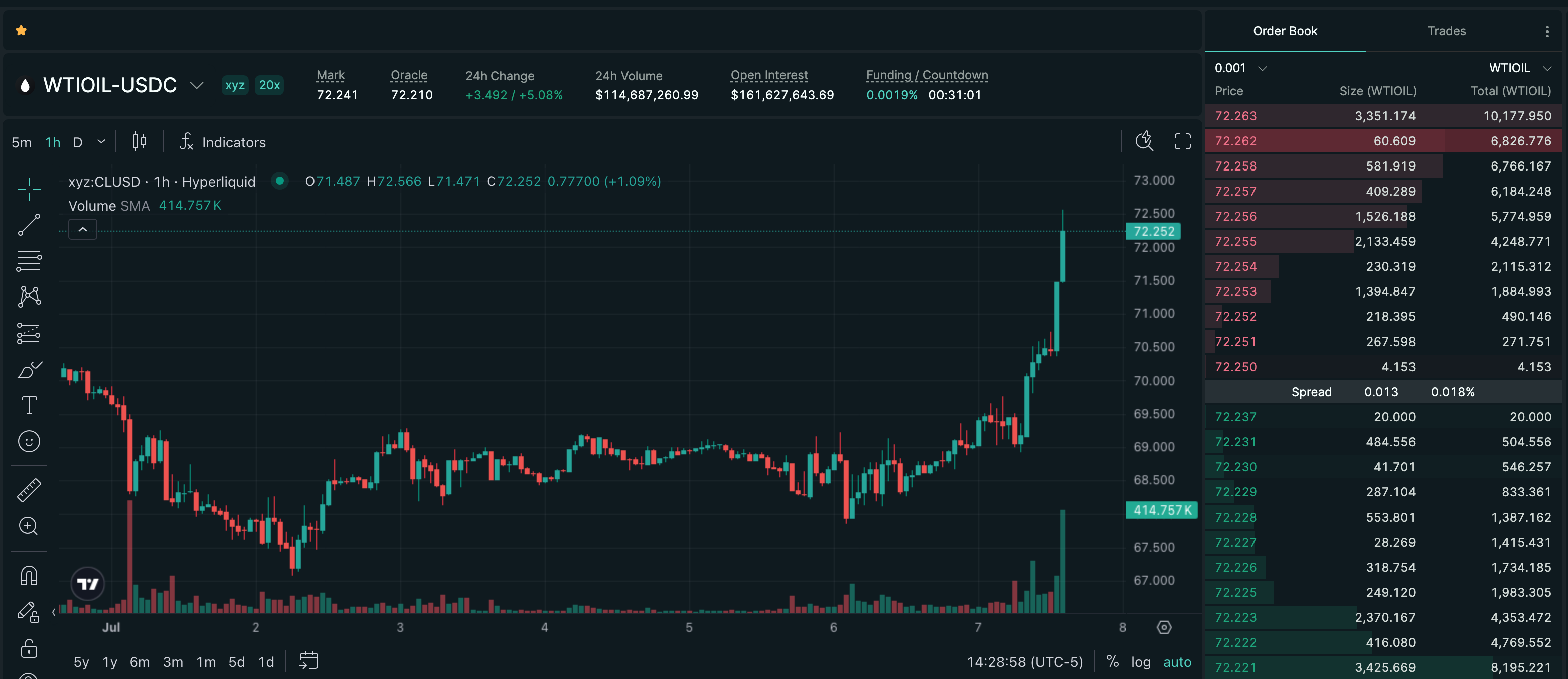
WTI ripped 5.16% to $72.22 after Iran struck the Qatari LNG carrier Al-Rekayyat and a Saudi supertanker near the Strait of Hormuz, reviving the supply-disruption fears that defined this spring's war. But the bounce is landing in a market that spent the past month grinding to its lowest levels since February. OPEC+ just approved another 188,000 bpd for August, and Saudi Aramco cut its Asian selling price by the most in over two decades. The setup is a fresh geopolitical premium colliding with a growing glut.
Mover Brief
Hormuz Draws Blood Again
On July 7, Iran struck the Qatari-owned LNG carrier *Al-Rekayyat* as it transited near the Strait of Hormuz, leaving a fire in its engine room that put the vessel at risk of exploding. A second ship — the Saudi supertanker *Wedyan* — was also reported damaged, and UKMTO logged multiple projectile incidents in and around the waterway that carries roughly a fifth of the world's seaborne oil. Oil prices rose more than 2% on the reports, with Bloomberg framing the attacks as a direct hit to shipping confidence. The timing matters: this comes barely three weeks after Trump and Pezeshkian signed a June 17 memorandum of understanding meant to end the war and reopen the strait. Two damaged hulls flying Qatari and Saudi flags make clear that truce is holding by a thread.
The Market It Spiked Into
Here's what makes this bounce awkward. Before July 7, WTI had round-tripped nearly the entire war premium, sliding to its lowest level since late February — down more than 20% over the prior month — after Brent peaked near $126 during the height of the crisis. Then the supply side got heavier, not lighter. On July 5, OPEC+ approved another 188,000 bpd output increase for August, with Saudi Arabia and Russia each adding 62,000 bpd as the group keeps unwinding its 2023 cuts. A day later, Saudi Aramco cut its Arab Light selling price for Asian buyers by the most in over two decades — roughly $11 a barrel — flipping last month's premium to a $1.50 discount against the Oman/Dubai benchmark. When the world's swing producer slashes prices that hard, it is telling you it sees soft demand and plenty of barrels. That is the tape this geopolitical spike is fighting.
Fade or Ride?
This is the second time in as many weeks that a Hormuz headline has forced traders to price a war premium into a fundamentally bearish market. Last week HIPERWIRE flagged WTI sliding back toward its pre-war floor as tankers kept clearing the strait and the risk premium quietly bled out. The open question is whether an actual hull-damaging strike on a Qatari and a Saudi vessel changes that calculus — or just hands the market another premium to sell. As long as the strait stays open and OPEC+ keeps adding barrels, every one of these spikes so far has been faded back toward the lows. The tail that flips the whole trade is a genuine closure of the strait or a direct hit on Gulf export infrastructure; short of that, a 5% rip off a two-week base is the market pricing fear, not lost supply.
Sources & Provenance
Citations below are preserved as structured Postgres source rows for this brief.
Citations Preserved
6
Reference links carried forward from the published mover record.
Original Signal
Open source tweetMarket Route
Direct route preserved for readers who want to inspect the tracked Hyperliquid market behind this archive entry.
Already onboarded? Open tracked market- 1CNBC — Oil prices rise more than 2% after attacks on tankers in Strait of Hormuzcnbc.com
- 2Bloomberg — Attacks on Ships in Strait of Hormuz Send Oil Prices Higherbloomberg.com
- 3Trading Economics — WTI Crude Oil price and market datatradingeconomics.com
- 4Wikipedia — 2026 Strait of Hormuz crisis (timeline of record)en.wikipedia.org
- 5Nairametrics — OPEC+ approves another 188,000 bpd output increase for Augustnairametrics.com
- 6BOE Report (Reuters) — Saudi Arabia cuts August Arab Light Asia OSP, biggest drop in over two decadesboereport.com
This content is for informational purposes only and does not constitute financial advice. Trading perpetual futures involves substantial risk of loss.
Trade CL on Hyperliquid
Use referral code HIPERWIRE for 4% off trading fees on your first $25M in volume.
Live Market Metrics
Monitor real-time open interest and funding for CL.