WTI Snaps Back Above $98 After Islamabad Talks Collapse and Trump Orders Hormuz Blockade
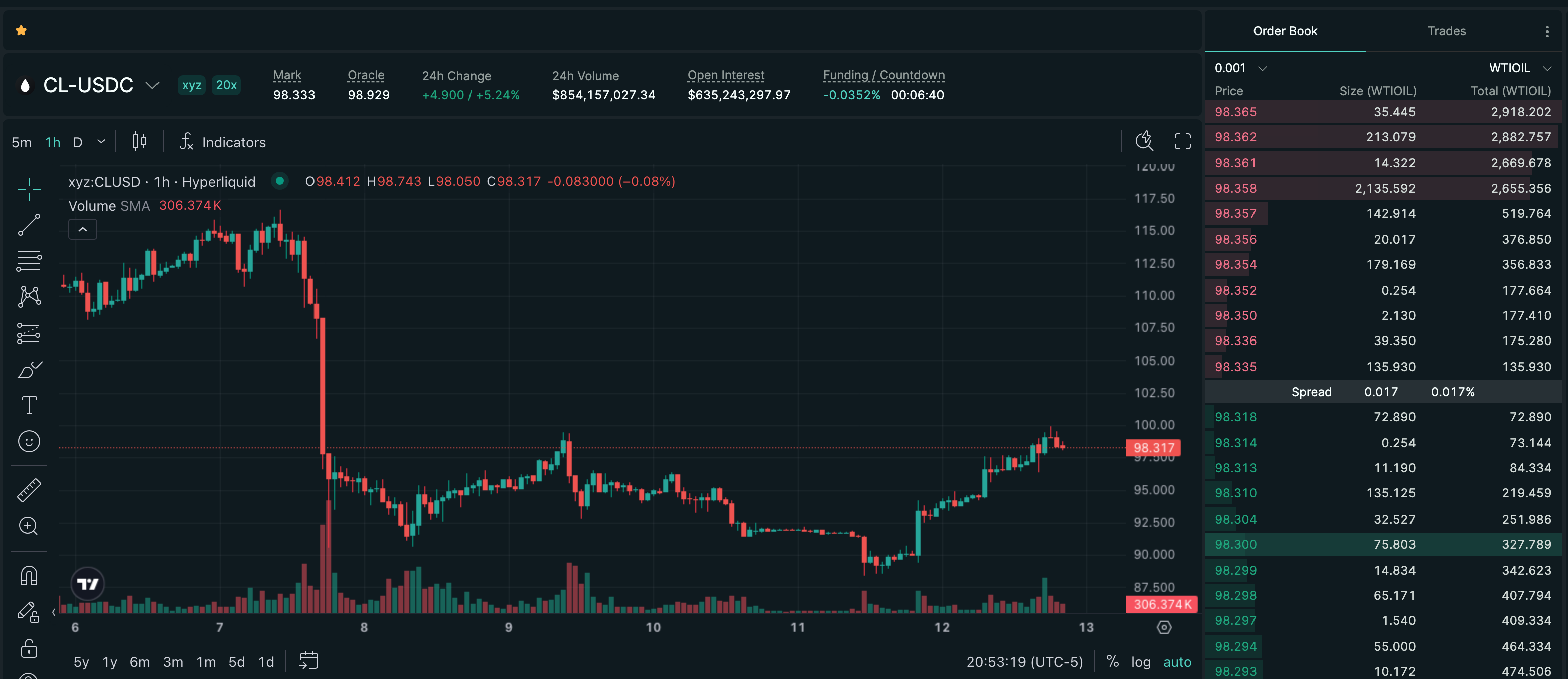
WTI crude reversed a week of ceasefire-driven selling after 21-hour peace talks between Vice President Vance and Iran's delegation fell apart in Islamabad on April 12. Trump immediately announced a US naval blockade of the Strait of Hormuz, with CENTCOM setting a Monday 10 a.m. ET start. The move reclaims roughly half of the 13% drawdown that followed the April 8 ceasefire announcement, with Goldman Sachs warning that another month of Hormuz closure keeps Brent above $100 for all of 2026.
Mover Brief
The Catalyst: Islamabad Collapses, Blockade Begins
The 21-hour marathon negotiations in Islamabad ended with no agreement on April 12 after the two sides hit an impasse on nuclear commitments. Vice President Vance demanded "an affirmative commitment that Iran will not seek a nuclear weapon," while Iran's delegation — led by Parliament Speaker Mohammad Bagher Ghalibaf — pushed a maximalist package: control of the Strait of Hormuz, release of $6 billion in frozen assets, war reparations, and a regional ceasefire covering Lebanon.
Neither side moved. Hours after Vance departed, Trump posted that the US Navy would blockade "any and all Ships trying to enter, or leave, the Strait of Hormuz" and intercept every vessel that had paid Iran's transit tolls. CENTCOM confirmed the blockade would take effect at 10 a.m. ET Monday. US Navy destroyers began mine-clearing operations in the strait the same day, though the IRGC claimed it forced one vessel back — a claim CENTCOM denied.
The result: WTI reversed hard, reclaiming roughly half of the 13% drawdown triggered by the April 8 ceasefire announcement that had briefly taken crude below $90.
Why the Ceasefire Selloff Was Premature
The April 8 ceasefire produced the sharpest single-day oil selloff since the COVID crash of April 2020, with traders rushing to unwind the geopolitical risk premium that had pushed WTI from $61 in January to $118 by late March. But the selloff front-ran a resolution that never materialized.
Goldman Sachs noted that despite the ceasefire, Iran still controls vessel flows through Hormuz, describing the strait as being in a "supervised pause" rather than actually reopened. Maritime analysts confirmed that coordination with Iranian armed forces is still required for all transits. Goldman's modeling shows Brent averaging above $100 for all of 2026 if the strait stays closed another month, and reaching $120 in Q3 under an extended closure scenario.
The underlying supply damage is real. Saudi Arabia has lost roughly 600,000 barrels per day of production capacity from infrastructure attacks, with East-West Pipeline throughput cut by another 700,000 bpd. Approximately 230 loaded tankers remain stuck in the Persian Gulf, and the 17.8 million barrels per day that normally transit Hormuz — about 20% of global consumption — are still disrupted.
What Comes Next
The blockade converts what had been Iran's de facto toll system into an overt US-enforced chokepoint. That changes the risk calculus in two ways: it removes the fiction that Hormuz was functionally open, and it puts US naval assets directly in the path of Iranian mines and IRGC fast boats.
JPMorgan has warned of $120 crude if the stalemate extends into mid-year. Macquarie's scenario analysis goes further — $200 if the conflict extends to June. The next scheduled catalyst is the OPEC+ meeting on May 3, where the group must decide whether to accelerate production increases now that any pretense of a quick resolution has collapsed.
For now, the market is repricing the probability that Hormuz reopens on any reasonable timeline. The ceasefire trade is dead. The question is whether the blockade escalation produces a new negotiating window or locks both sides into a protracted standoff that keeps crude well above $100 through the summer.
Sources & Provenance
Citations below are preserved as structured Postgres source rows for this brief.
Citations Preserved
7
Reference links carried forward from the published mover record.
Original Signal
Open source tweetMarket Route
Direct route preserved for readers who want to inspect the tracked Hyperliquid market behind this archive entry.
Already onboarded? Open tracked market- 1Al Jazeera — US and Iran Fail to Reach Deal After Marathon Talksaljazeera.com
- 2Axios — Oil Prices Surge on Trump's Blockade Vowaxios.com
- 3NBC News — Live Updates: US-Iran Fail to Reach Dealnbcnews.com
- 4Goldman Sachs via OilPrice — Another Month of Hormuz Closure Means Over $100 Brentoilprice.com
- 5Washington Times — Navy Begins Mine-Clearing in Strait of Hormuzwashingtontimes.com
- 6EIA — Crude Oil Prices Increased Sharply in Q1 2026eia.gov
- 7Fortune — How a US Naval Blockade of the Strait of Hormuz Could Workfortune.com
This content is for informational purposes only and does not constitute financial advice. Trading perpetual futures involves substantial risk of loss.
Trade CL on Hyperliquid
Use referral code HIPERWIRE for 4% off trading fees on your first $25M in volume.
Live Market Metrics
Monitor real-time open interest and funding for CL.