Micron Bounces 6% Off TurboQuant Panic Lows
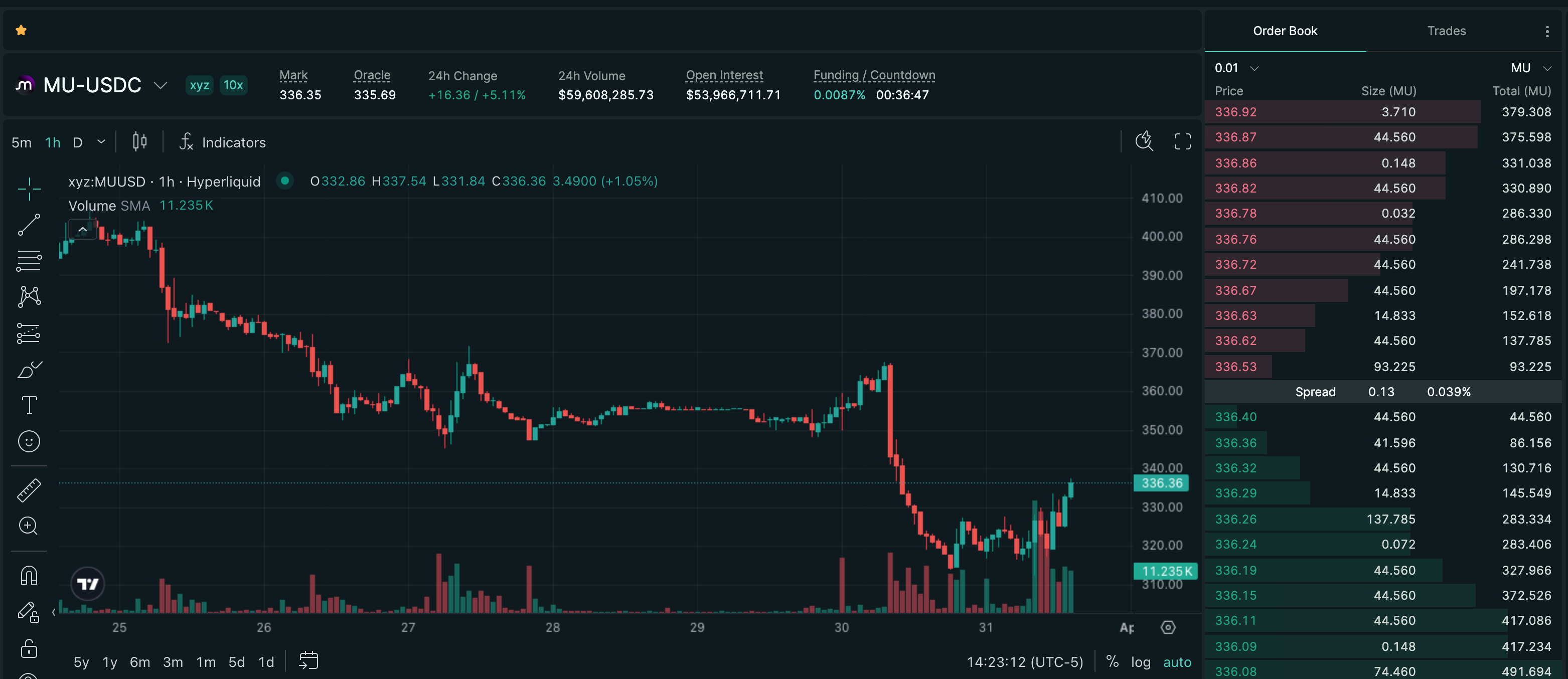
Micron Technology shares snapped back over 6% after touching $311 on March 30, the deepest point of a 30% drawdown triggered by Google's TurboQuant compression algorithm. No new catalyst drove the bounce — this is an oversold rebound in a stock that still trades below 7x forward earnings with its entire 2026 HBM capacity under binding contract.
Mover Brief
The TurboQuant Shock
Google announced TurboQuant on March 25 — a KV cache compression technique that squeezes inference memory requirements down to 3 bits per value, a 6x reduction from the standard 16-bit representation. No retraining required, no accuracy loss across question answering, code generation, and summarization benchmarks. On Nvidia H100s, 4-bit TurboQuant delivered up to 8x speedup in attention computation.
The market read this as an existential threat to Micron's AI thesis. If hyperscalers can compress their memory footprint by 6x through software alone, the insatiable HBM demand narrative gets a lot less insatiable. MU dropped nearly 10% on March 30 alone on 72.4 million shares — almost double the three-month average volume. From the February high near $455, the total drawdown hit roughly 30%, with shares touching $311.49 intraday.
Why the Bounce Has No Name
There is no confirmed catalyst behind this 6% move. No analyst upgrade, no company announcement, no policy shift. What happened is simpler: MU got cheap enough that buyers stepped in.
The stock fell to less than 7x 2026 earnings estimates after a company that just tripled revenue year-over-year to $23.86 billion and posted 74.9% gross margins. Of 43 analysts covering MU, 38 still rate it Buy with a consensus target of $527.60 — roughly 60% above where it bounced. Cantor Fitzgerald holds a Street-high target of $700. Citi trimmed to $425 from $510 but held its Buy rating. When the consensus target is that far above the trading price, dip buyers show up.
The broader bull case hasn't changed: Micron's entire calendar 2026 HBM4 production is locked under binding contracts. Q3 guidance calls for $33.5 billion in revenue at ~81% gross margins. The earnings trajectory is software-company-grade, not memory-cyclical-grade.
Is the TurboQuant Thesis Actually Bearish?
The strongest counterargument to the TurboQuant panic is historical: efficiency gains in computing have never permanently reduced demand for the underlying hardware. They make the technology cheaper and more accessible, which expands adoption, which eventually drives more hardware consumption. Flash storage got cheaper per gigabyte for two decades, and total NAND demand grew every single year.
TurboQuant compresses the KV cache — the working memory that LLMs use during inference. Even a 6x compression doesn't touch training memory requirements, which is where HBM demand is most acute. And if inference becomes 6x cheaper to run, the economic case for deploying AI inference at the edge, on mobile, and in latency-sensitive applications gets dramatically stronger. More inference endpoints means more total memory deployed, not less.
That said, the short-term demand impact on HBM-for-inference is real. If hyperscalers can serve the same inference load with one-sixth the memory, near-term purchase orders could get pushed out. The question is whether the demand expansion from cheaper inference catches up before Micron's forward contracts roll off. For 2026, that question is moot — the capacity is already sold.
What to Watch
The immediate technical question is whether MU holds the $310-315 zone that formed the March 30 low. A retest and hold would confirm a tradeable bottom in a stock that's still fundamentally mispriced relative to its earnings power. A break below $310 opens the door to $280-290, where the stock traded before the Q2 earnings beat.
On the fundamental side, the May quarter report will be the first to reflect any real-world TurboQuant impact on customer ordering patterns. Guidance commentary on HBM contract extensions into 2027 matters more than the headline numbers. If Micron signals that 2027 HBM is filling up on schedule despite the compression narrative, the TurboQuant bear case is effectively dead.
Micron also announced a $5 billion increase in fiscal 2026 capital expenditure, which added to selling pressure last week. Whether that capex translates into share gains in the HBM market or margin compression will be a defining question for the next two quarters.
Sources & Provenance
Citations below are preserved as structured Postgres source rows for this brief.
Citations Preserved
7
Reference links carried forward from the published mover record.
Original Signal
Open source tweetMarket Route
Direct route preserved for readers who want to inspect the tracked Hyperliquid market behind this archive entry.
Already onboarded? Open tracked market- 1TechCrunch — Google Unveils TurboQuant AI Memory Compression Algorithmtechcrunch.com
- 2Tom's Hardware — TurboQuant Compresses LLM KV Caches to 3 Bitstomshardware.com
- 3VentureBeat — Google TurboQuant Speeds Up AI Memory 8xventurebeat.com
- 4Motley Fool — Stock Market Today: Micron Falls on TurboQuant Shockfool.com
- 5Motley Fool — Micron Technology Is Having Its Nvidia Momentfool.com
- 6FinancialContent — The Memory Paradox: Decoding Micron's 2026 AI Supercycle Correctionmarkets.financialcontent.com
- 7Yahoo Finance — Micron Plans $5B Capex Increase for Fiscal 2026finance.yahoo.com
This content is for informational purposes only and does not constitute financial advice. Trading perpetual futures involves substantial risk of loss.
Trade MU on Hyperliquid
Use referral code HIPERWIRE for 4% off trading fees on your first $25M in volume.
Live Market Metrics
Monitor real-time open interest and funding for MU.