Micron Round-Trips Its Record Quarter as Insider Selling Hits the Fastest Pace Since 2010
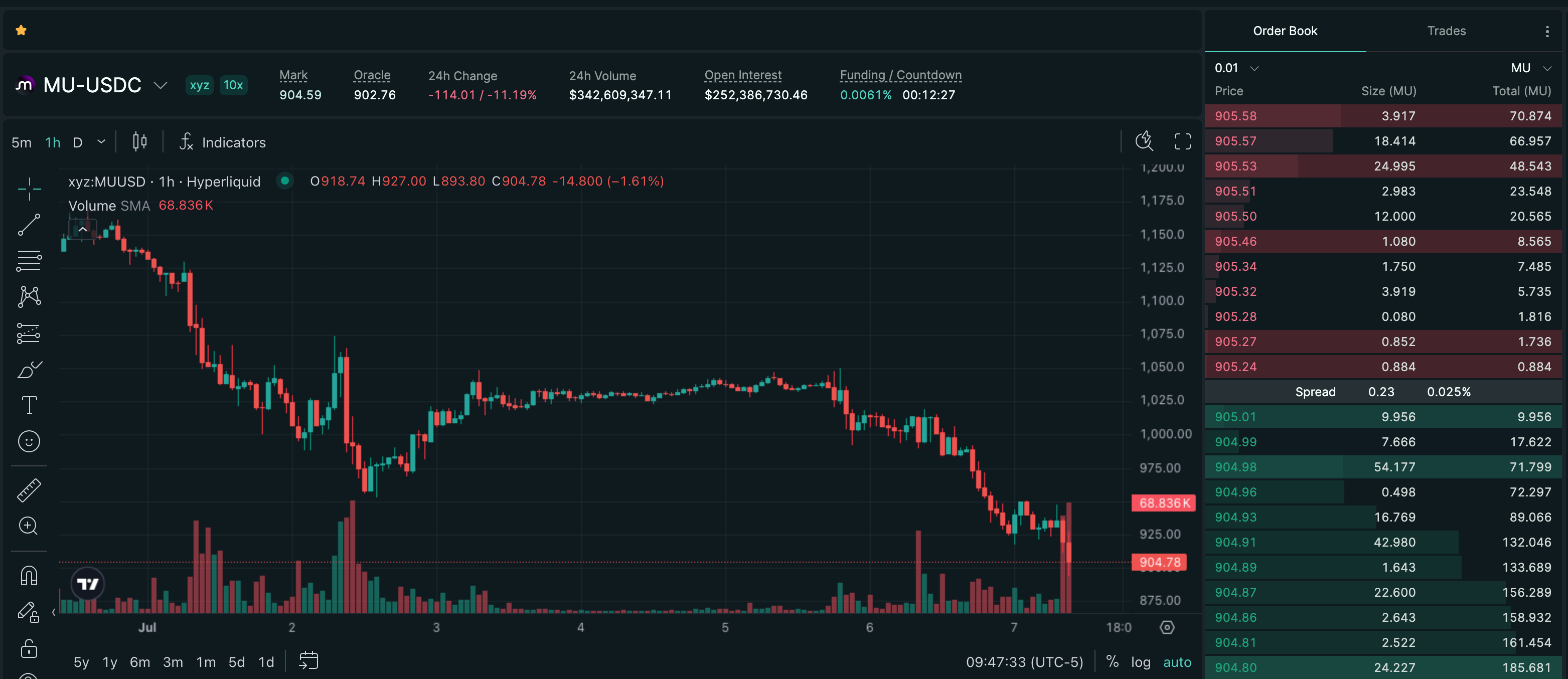
Micron's Hyperliquid perp has given back 10.79% over the past 23 hours to $903.90, unwinding the post-earnings gains from the company's record June quarter. The proximate trigger is positioning, not fundamentals: insider selling has hit its fastest pace since 2010, with CEO Sanjay Mehrotra offloading roughly $46 million near the top and the company's ledger showing 36 insider sales against a single buy over the past year. Hanging over it is a cheaper HBM comparable, SK Hynix's $28 billion Nasdaq listing that prices this week, plus a fresh DRAM price-fixing suit. This is what a crowded momentum trade looks like when the easy money starts heading for the door.
Mover Brief
The Round-Trip
Micron's Hyperliquid perp has shed 10.79% over the past 23 hours to $903.90, on roughly $342 million of 24-hour volume in this market alone. Set against the tape, that puts the contract about a quarter below the ~$1,190 highs it printed in late June — a near-complete round-trip of the post-earnings move that followed Micron's record fiscal quarter reported June 24.
Nothing in the numbers broke. Guidance is intact and demand for AI memory hasn't cracked. What changed is positioning. After a roughly 4x run in the first half of 2026, MU became one of the most crowded momentum trades in the market, and crowded trades unwind fast when the marginal buyer steps back. The June 23 South Korean ETF warning that first cracked the chip complex set the tone; the last two weeks have been the air coming out.
Insiders Head for the Exit
The cleanest tell is coming from inside the building. Per desk analysis flagged by Oppenheimer, Micron insider selling is running at its fastest pace since 2010. CEO Sanjay Mehrotra has been the most active seller: SEC Form 4 filings show him selling 40,000 shares at $536.26 on May 1, another 37,439 at a weighted $960.38 on May 29, and 38,030 shares for roughly $46 million on June 26 at prices between $1,128 and $1,192 — effectively the top. Across the company, the past year's ledger reads 36 insider sales against a single buy, with zero purchases in the last 30 days.
The honest caveat: every Mehrotra sale ran through a Rule 10b5-1 plan adopted on January 30, 2026, before the AI-driven melt-up. These are pre-scheduled, price-blind trades, not a discretionary bet against the stock, and Mehrotra still holds around 344,000 shares directly plus another 607,000 through trusts. But the market rarely parses that distinction in real time. When the tape is already heavy, 'record insider selling' is a headline that feeds the selling regardless of the mechanics.
A Cheaper HBM Comp Arrives
The structural overhang is landing this week. SK Hynix — the HBM leader with 57% of the market by revenue in Q4 2025 — is pricing a Nasdaq listing that hands US investors a direct, cheaper way to own the AI-memory trade. The terms unveiled July 6 put the deal at roughly $28.1 billion — 177.9 million ADS at about $158.14 apiece — with pricing expected July 9 and trading July 10. At that size it would be the largest share sale since SpaceX.
The problem for Micron is the relative math. SK Hynix is coming public at about 6.2x forward earnings versus Micron's 7x, and 3.6x forward EV/sales against Micron's 4.6x. Micron has historically traded at roughly a 35% premium to SK Hynix, justified largely by better US-investor access — an edge that shrinks the moment SK Hynix trades on Nasdaq. HSBC expects the ADR to start closing that gap, applying a 20% premium and a ~$166 target. A purer, cheaper HBM comparable listing 48 hours from now caps how much premium Micron can defend, and the stock is repricing for it in advance.
The Price-Fixing Overhang
The last piece is legal. On June 25 a federal class action was filed in the Northern District of California accusing Micron, Samsung, and SK Hynix — who together control roughly 90% of the DRAM market — of colluding to restrict supply. The specific allegation is pointed: that the three shifted about 25% of DRAM wafer capacity to high-margin HBM since 2022, starving the DDR4/DDR5 market and driving consumer memory prices up as much as 700% over four years. Micron denies the claims and says it competes fairly.
DRAM antitrust suits have a two-decade history of going nowhere, so this is unlikely to be a fundamental threat on its own. But it's one more reason for a stretched, momentum-owned name to see profit-taking instead of dip-buying. Stack it with record insider selling and a cheaper comp pricing Thursday, and the round-trip to $903.90 stops looking like an accident.
Sources & Provenance
Citations below are preserved as structured Postgres source rows for this brief.
Citations Preserved
7
Reference links carried forward from the published mover record.
Original Signal
Open source tweetMarket Route
Direct route preserved for readers who want to inspect the tracked Hyperliquid market behind this archive entry.
Already onboarded? Open tracked market- 1SEC Form 4 — Micron insider trading activity (StockTitan)stocktitan.net
- 224/7 Wall St. — Insiders dumping Micron at the highest rate since 2010247wallst.com
- 3CNBC — SK Hynix plans $29B Nasdaq ADR listing as soon as July 10cnbc.com
- 4IPOScoop — SK Hynix launches $28.13B U.S. offering (177.9M ADS at ~$158.14)iposcoop.com
- 5CNBC — HSBC sees SK Hynix ADR worth 20% more, ~$166 targetcnbc.com
- 6Fortune — SK Hynix's $29B U.S. listing and the Micron valuation gapfortune.com
- 7Tom's Hardware — Samsung, SK Hynix and Micron face DRAM price-fixing lawsuittomshardware.com
This content is for informational purposes only and does not constitute financial advice. Trading perpetual futures involves substantial risk of loss.
Trade MU on Hyperliquid
Use referral code HIPERWIRE for 4% off trading fees on your first $25M in volume.
Live Market Metrics
Monitor real-time open interest and funding for MU.