Micron Snaps Back Nearly 9% as Iran Tensions Cool and AI Memory Demand Stays Red-Hot
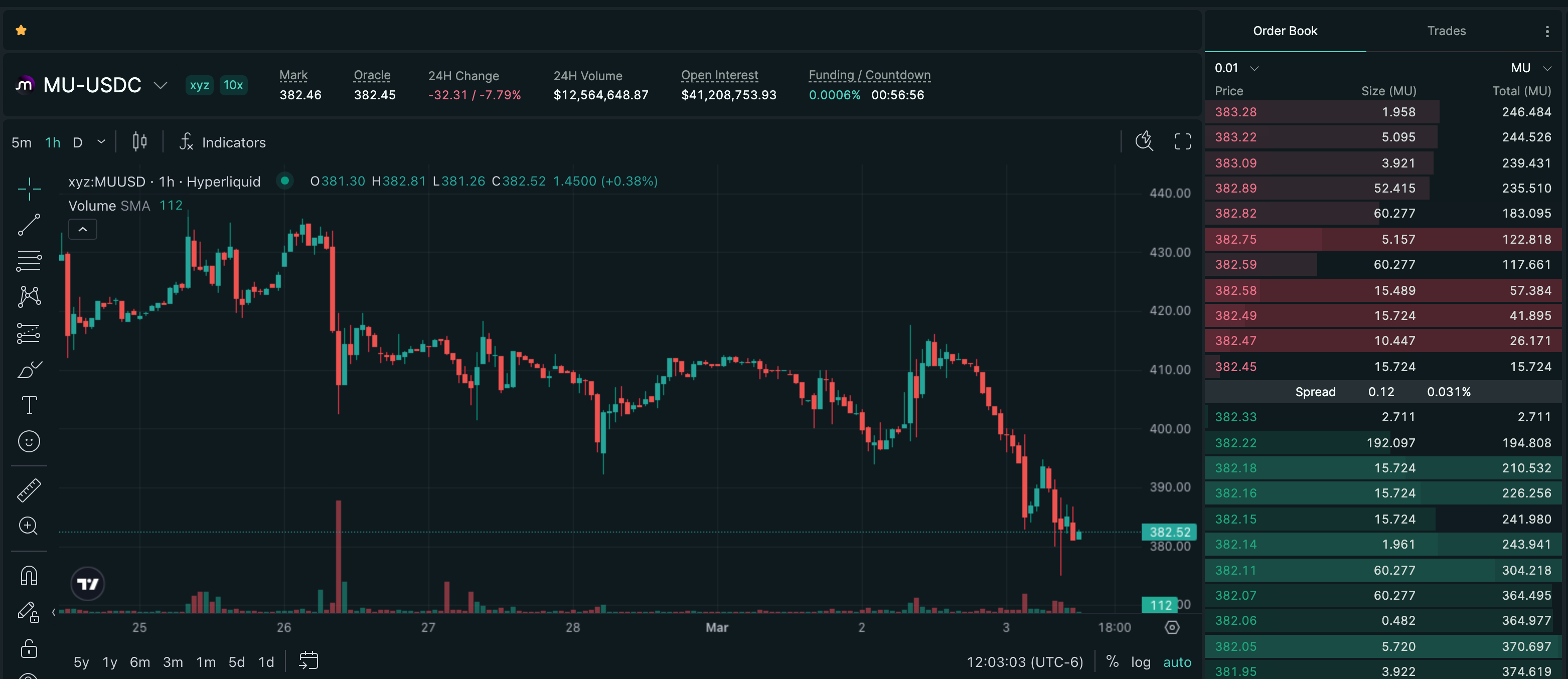
Micron Technology (MU) ripped 8.89% over 21 hours on Hyperliquid perps, recovering nearly all of a brutal geopolitics-driven sell-off from the prior session. The bounce came as Iran signaled willingness to negotiate a quick end to the U.S.-Israel conflict, reversing the fear trade that had cratered semiconductor stocks — and it didn't hurt that Micron dropped a landmark AI memory product announcement right into the chaos.
Mover Brief
What Happened
On March 3, MU fell as much as 9.47% alongside a broad tech rout sparked by escalating tensions in the Middle East. Oil prices surged on fears of a Strait of Hormuz closure, and the Nasdaq dropped 1.4% as traders dumped anything growth-sensitive. Micron, as a high-beta semiconductor name with significant global supply chain exposure, took an outsized hit.
Then, on March 4, the script flipped. Reports surfaced that Iran's intelligence services had signaled willingness to negotiate, and risk appetite came roaring back. The S&P 500 recovered 0.8%, the Nasdaq bounced 1.3%, and MU led the charge — gaining over 7% on the equity side by midday. On Hyperliquid's HIP-3 perp, the move printed even sharper, with MU rallying 8.89% to $400.80 as leveraged traders piled into the reversal.
This wasn't just a Micron story. The entire semiconductor complex whipsawed with the geopolitical headlines, but memory names like MU were particularly volatile given their sensitivity to energy costs and global trade flows.
Why It Moved
The primary catalyst was macro: a classic geopolitical de-escalation bounce. Tuesday's sell-off was driven by fear of sustained conflict disrupting energy supplies and reigniting inflation — a nightmare scenario for capital-intensive chipmakers. When Iran hinted at negotiations Wednesday morning, the compression trade unwound fast. MU's high beta meant it fell harder and bounced harder than most.
But there's a fundamental layer underneath that made this bounce stickier than a pure risk-on snapback. On the same day as the sell-off, Micron announced it had begun shipping customer samples of the world's first 256GB SOCAMM2 LPDRAM module for AI data centers. This is built on Micron's industry-first monolithic 32Gb LPDDR5X design and delivers 2TB per 8-channel CPU at one-third the power and one-third the footprint of equivalent RDIMMs. Micron claims 2.3x faster time to first token for long-context LLM inference and 3x better performance per watt in HPC workloads. The module will be showcased alongside NVIDIA at GTC 2026.
Analysts are also paying attention. Goldman Sachs raised its MU price target from $235 to $360 while maintaining a neutral rating — and they're on the conservative end. UBS and Stifel have targets at $475 and $550 respectively, both reiterating Buy. Out of 35 analysts covering the stock, 31 have Buy or Strong Buy ratings.
The bigger picture is that Micron's HBM capacity is sold out through the end of calendar 2026, including next-generation HBM4 products. The company forecasts the HBM total addressable market growing at a 40% annual rate through 2028, from $35 billion in 2025 to roughly $100 billion. Micron's $1.8 billion acquisition of Powerchip's P5 fab in Taiwan — expected to close by Q2 2026 with DRAM output beginning in H2 2027 — further cements its capacity expansion story.
What to Watch
The most important date on the calendar is March 18, when Micron reports fiscal Q2 2026 earnings. Consensus estimates are massive: $19.07 billion in revenue and $8.58 normalized EPS. For context, Q1 came in at $13.64 billion revenue and $4.78 EPS (non-GAAP), already beating estimates by 25%. A beat-and-raise here could send MU into price discovery territory.
Geopolitics remains the wildcard. If Iran negotiations break down or the Middle East situation escalates again, the same fear trade that hit MU on Tuesday could return with force. Energy costs matter for fabs, and supply chain disruptions through the Strait of Hormuz would ripple through the entire semiconductor ecosystem.
On the product side, watch for customer reception of the 256GB SOCAMM2 at GTC 2026 and any commentary on HBM4 ramp timelines. The NVIDIA co-design partnership is a signal that Micron is positioning itself as a preferred memory supplier for next-gen AI infrastructure — but execution on these ramps is everything.
Sources & Provenance
Citations below are preserved as structured Postgres source rows for this brief.
Citations Preserved
8
Reference links carried forward from the published mover record.
Original Signal
Open source tweetMarket Route
Direct route preserved for readers who want to inspect the tracked Hyperliquid market behind this archive entry.
Already onboarded? Open tracked market- 1Trade MU on Hyperliquidapp.hyperliquid.xyz
- 2Why Micron Stock Is Plummeting Today — The Motley Foolfool.com
- 3Why Micron Stock Is Soaring Today — The Motley Foolfool.com
- 4Micron Sets New Benchmark With 256GB LPDRAM SOCAMM2 — GlobeNewsWireglobenewswire.com
- 5MU Stock Breaks Out as AI Memory Tightness Extends — MarketBeatmarketbeat.com
- 6Micron Q1 FY2026 Earnings — Micron Investor Relationsinvestors.micron.com
- 7Micron to Purchase PSMC Fab for $1.8B — Manufacturing Divemanufacturingdive.com
- 8Analysts Raise MU Price Targets — The Motley Foolfool.com
This content is for informational purposes only and does not constitute financial advice. Trading leveraged perpetuals carries substantial risk of loss.
Trade MU on Hyperliquid
Use referral code HIPERWIRE for 4% off trading fees on your first $25M in volume.
Live Market Metrics
Monitor real-time open interest and funding for MU.