WTI Breaks $100 After Iran Kills the 15-Point Peace Plan
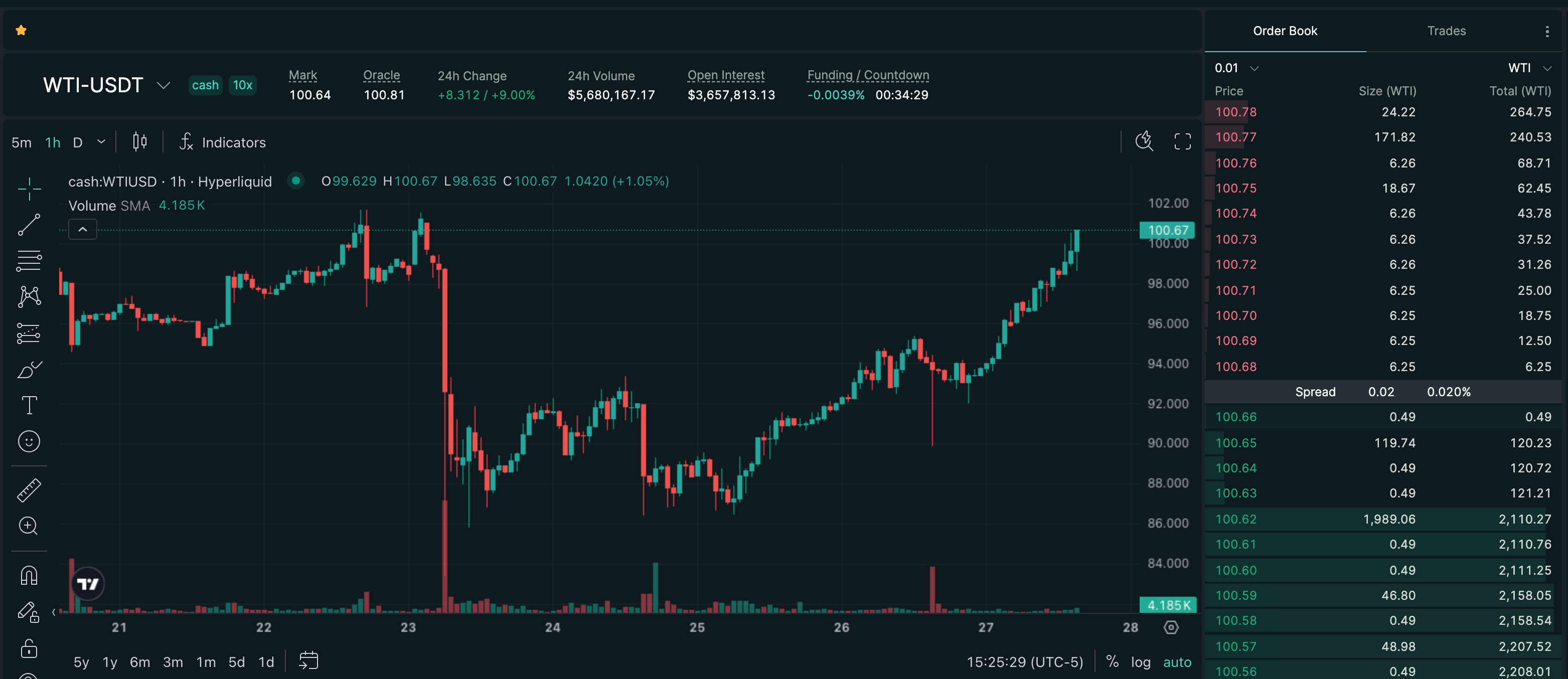
WTI crude hit a session high of $100.04 on March 27 after Iranian Foreign Minister Abbas Araghchi rejected the U.S. 15-point peace framework, declaring Tehran has no plans for direct negotiations. The Strait of Hormuz remains effectively closed to Western-aligned shipping, with only four AIS-tracked vessel transits on Tuesday against a pre-war baseline of 120 per day. With nearly 500 million barrels of cumulative supply lost since the crisis began on February 28, the market is now pricing in a prolonged disruption through Q2.
Mover Brief
Iran Kills the Deal
The move had a single catalyst: Iran's Foreign Minister Abbas Araghchi told state television on Wednesday that "no negotiations have happened with the enemy until now, and we do not plan on any negotiations." This torpedoed a brief window of optimism that opened on March 25 when the U.S. published a 15-point peace framework demanding the dismantling of Iran's nuclear capabilities, removal of enriched uranium stockpiles, and designation of the Strait of Hormuz as a "free maritime zone."
Tehran's counter was a 5-point proposal demanding war reparations and formal international recognition of Iranian authority over the Strait. The White House immediately dismissed those terms. Trump issued what officials described as a "final blow" warning, stating Iran must "get serious" or face escalated military action — though he simultaneously paused strikes on Iranian energy infrastructure for 10 days through April 6.
The diplomatic collapse sent WTI from the low $90s to a session high of $100.04 — its first triple-digit print since July 2022. U.S. crude closed at $99.64, up 5.46% on the day.
The Strait Is Still Closed
The fundamental supply picture hasn't improved. The Strait of Hormuz — which handles roughly 20% of the world's seaborne oil — has been effectively shut to Western-aligned shipping since the crisis began on February 28, when U.S.-Israeli strikes killed Supreme Leader Khamenei.
Iran's IRGC has turned the strait into a selective toll booth. Vessels must submit documentation to IRGC intermediaries and receive clearance codes; approved ships get Iranian naval escorts through territorial waters around Larak Island. Some operators have reportedly paid $2 million per transit, with at least two payments made in Chinese yuan. Ships from China, Russia, India, and several non-aligned nations can negotiate passage. The U.S. and allies are blocked outright.
The numbers tell the story: only 4 AIS-tracked transits on Tuesday against a pre-war average of 120 per day. Nearly 2,000 vessels are anchored on both sides of the strait waiting for clearance. Regional exports have fallen from 25 million barrels per day pre-war to roughly 10 million — a 60% cut. Iraqi production alone dropped from 4.3 million to 1.3 million barrels per day.
What the Market Is Pricing
Goldman Sachs estimates an $18 per barrel geopolitical risk premium baked into current prices, with a Q2 average projection of $110 Brent and an extreme upside scenario of $135 if the market prices in a six-month disruption. OECD inventories are 180 million barrels below their five-year average, leaving little buffer.
Not everything is bullish. The EIA's weekly petroleum status report showed a surprise crude inventory build of +6.9 million barrels for the week ending March 20, well above expectations. And Trump's 10-day strike pause creates a narrow window where de-escalation is at least theoretically possible — any genuine progress on reopening the strait would trigger aggressive short-covering.
But the base case is ugly. Iran is demanding sovereignty recognition over the waterway and war reparations. The U.S. is threatening escalation. Oil prices have climbed more than 40% since the February 28 strikes, and the diplomatic off-ramp that briefly appeared this week just got demolished. The question is no longer whether WTI holds $100 — it is how far above $100 the market reprices if the strait stays closed into Q2.
Sources & Provenance
Citations below are preserved as structured Postgres source rows for this brief.
Citations Preserved
7
Reference links carried forward from the published mover record.
Original Signal
Open source tweetMarket Route
Direct route preserved for readers who want to inspect the tracked Hyperliquid market behind this archive entry.
Already onboarded? Open tracked market- 1CNBC — Oil prices close at highest level since 2022 as Iran negotiations failcnbc.com
- 2Al Jazeera — Oil prices rise as Iran denies US talksaljazeera.com
- 3Al Jazeera — Tehran's 'toll booth': How Iran picks who transits the Straitaljazeera.com
- 4FX Leaders — WTI surges 4.6% as Iran rejects peace talksfxleaders.com
- 5Wikipedia — 2026 Strait of Hormuz crisisen.wikipedia.org
- 6EIA Weekly Petroleum Status Reporteia.gov
- 7Reuters — Oil prices stay elevated across Iran war scenariosreuters.com
This content is for informational purposes only and does not constitute financial advice. Trading perpetual futures involves substantial risk of loss.
Trade WTI on Hyperliquid
Use referral code HIPERWIRE for 4% off trading fees on your first $25M in volume.
Live Market Metrics
Monitor real-time open interest and funding for WTI.