WTI Drops 14% as Trump Claims Iran Talks That Tehran Says Don't Exist
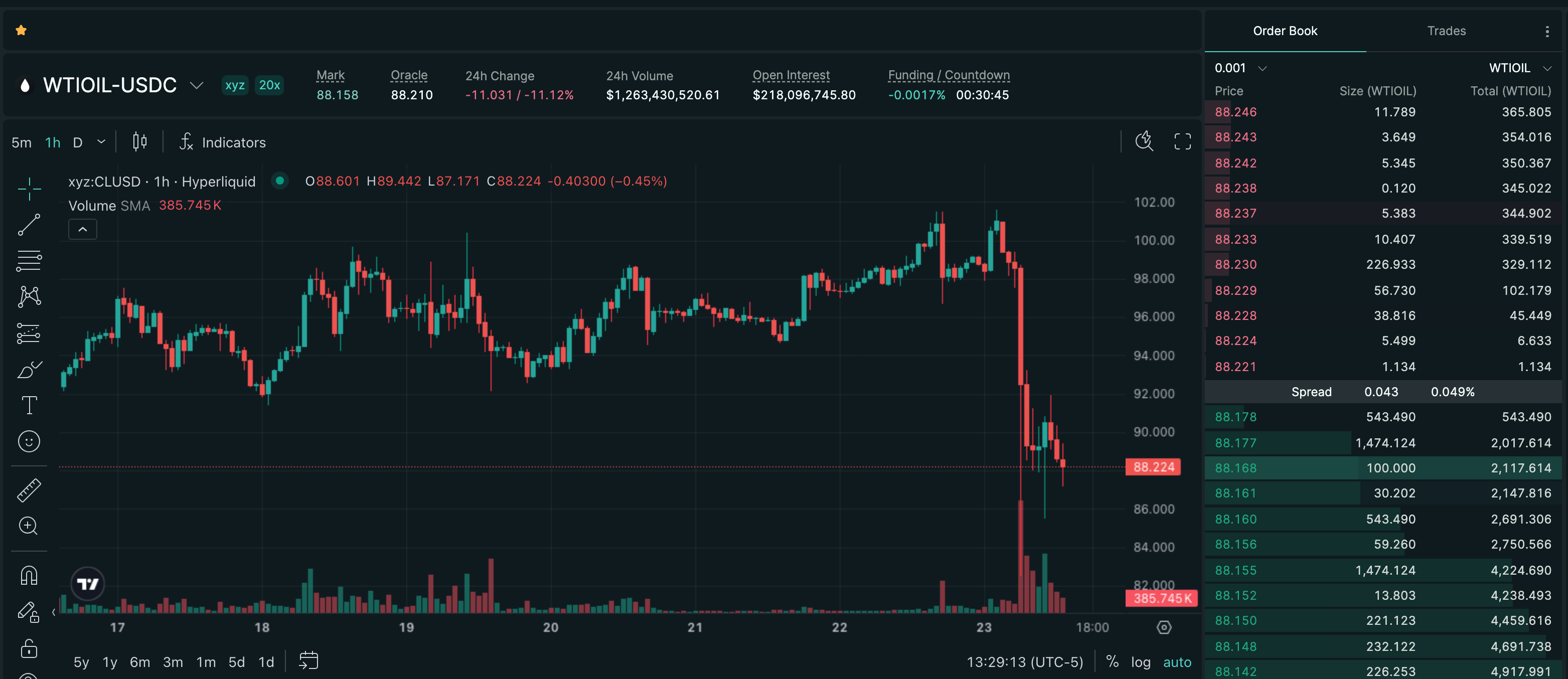
WTI crude extended losses below $88 as markets processed contradictory signals from Washington, Tehran, and Swiss mediators. Trump ordered a five-day pause on strikes against Iranian energy infrastructure and claimed productive back-channel conversations, but his Truth Social post was briefly deleted and reposted with edits, and Iran flatly denied any contact with the United States. Swiss mediators then confirmed a mutual de-escalation framework exists, leaving the market to price a ceasefire built on three incompatible narratives.
Mover Brief
The Deleted Post
Trump posted on Truth Social Monday morning that he had instructed the Department of War to postpone all military strikes against Iranian power plants and energy infrastructure for five days, claiming "very good and productive conversations" with Tehran. The post was briefly deleted and reposted with a typo correction — changing "witch" to "which" — a detail that matters because the deletion itself moved markets. Brent dropped from roughly $113 to $98 on the initial post, partially recovered during the deletion window, then resumed falling when the corrected version appeared.
This reversed Trump's 48-hour ultimatum from Saturday demanding Iran reopen the Strait of Hormuz or face strikes on power grids. WTI hit an intraday low of $85.28 — a 14% drop — before settling around $87.52. The Dow gained over 700 points, the Russell 2000 added 2.8%, natural gas fell 6%, European gas futures dropped 9%, and heating oil lost 12%.
Vandana Hari of Vanda Insights framed the move bluntly: Trump appeared to be withdrawing his Hormuz ultimatum under pressure and "dressed it up as negotiations going on" to avoid the appearance of backing down. Whether that reading is correct or not, the market registered it the same way — a de-escalation signal worth roughly 14% of the war premium in a single session.
Three Contradictory Narratives
The problem is that nobody agrees on what actually happened.
Washington's version: Trump told Fox Business that Iran "called" to negotiate and that a deal could come "within days." Envoys Steve Witkoff and Jared Kushner are supposedly engaged in back-channel diplomacy. Trump suggested the Strait of Hormuz could be "open very soon" without providing specifics.
Tehran's version: Iran's Mehr news agency relayed that "there is no dialogue between Tehran and Washington" and characterized the pause as Trump "backing down" after Iran threatened to permanently close the Strait and strike energy infrastructure across Israel and the Gulf states if power plants were hit.
Switzerland's version: The Swiss Foreign Ministry, acting as mediator, confirmed a "mutual de-escalation framework" had been reached — the most substantive of the three claims, and one that neither belligerent has publicly acknowledged.
UBS economist Paul Donovan noted that "statements from top U.S. administration officials give different and at times contradictory assessments of the war." Brent's bounce from $98 back to $105 after Iran's denial illustrates the dynamic: the de-escalation trade keeps getting partially unwound by the very parties it depends on.
Reading the Floor
This is the third de-escalation signal in two weeks. On March 10, Trump's "winding down" post briefly pushed WTI below $80. On March 21, Treasury's 140 million barrel Iranian oil waiver took it to $93 before a full reversal within 24 hours. Now the five-day strike pause has broken below $88 — but the floor is stepping higher with each cycle.
Pre-war: $65. After the first head-fake: $80. After the second: $93 briefly. After the third: $85-88. Each cycle removes less premium because the structural damage accumulates independent of rhetoric. The Strait of Hormuz remains effectively closed. Iraq's force majeure on foreign-operated oilfields still holds, keeping 2.4 million bpd offline from Basra. Iran's strikes on Gulf infrastructure — Qatar's Ras Laffan LNG terminal, Kuwait's Mina Al-Ahmadi refinery — caused physical damage measured in years of repairs, not days.
The five-day window expires March 28. If the Swiss framework produces something concrete, crude has room to retest $80. If it collapses like the prior two signals — both of which were walked back within 48 hours by troop deployments, new strikes, or Iranian retaliation — the war premium rebuilds and the floor steps up again. At $87.52, WTI is pricing a resolution that arrives this week. The track record of that bet is 0-for-2.
Sources & Provenance
Citations below are preserved as structured Postgres source rows for this brief.
Citations Preserved
6
Reference links carried forward from the published mover record.
Original Signal
Open source tweetMarket Route
Direct route preserved for readers who want to inspect the tracked Hyperliquid market behind this archive entry.
Already onboarded? Open tracked market- 1CNBC — Oil tumbles after Trump puts hold on strikes against Iran energy infrastructurecnbc.com
- 2NBC News — U.S. stocks rise, oil prices fall after Trump backs off Iran threatnbcnews.com
- 3Business Today — Crude's wild hour: How Trump's Iran post and correction swung oil marketsbusinesstoday.in
- 4Reuters via Investing.com — Oil falls over 13% on Trump postponing military strikes on Iraninvesting.com
- 5FinancialContent — Swiss mediation confirms mutual de-escalation frameworkmarkets.financialcontent.com
- 6NBC News — Live updates: Trump postpones strikes on Iran power plants amid talksnbcnews.com
This content is for informational purposes only and does not constitute financial advice. Trading perpetual futures involves substantial risk of loss.
Trade CL on Hyperliquid
Use referral code HIPERWIRE for 4% off trading fees on your first $25M in volume.
Live Market Metrics
Monitor real-time open interest and funding for CL.