WTI Dumps 12% After Trump Orders Five-Day Pause on Iran Energy Strikes
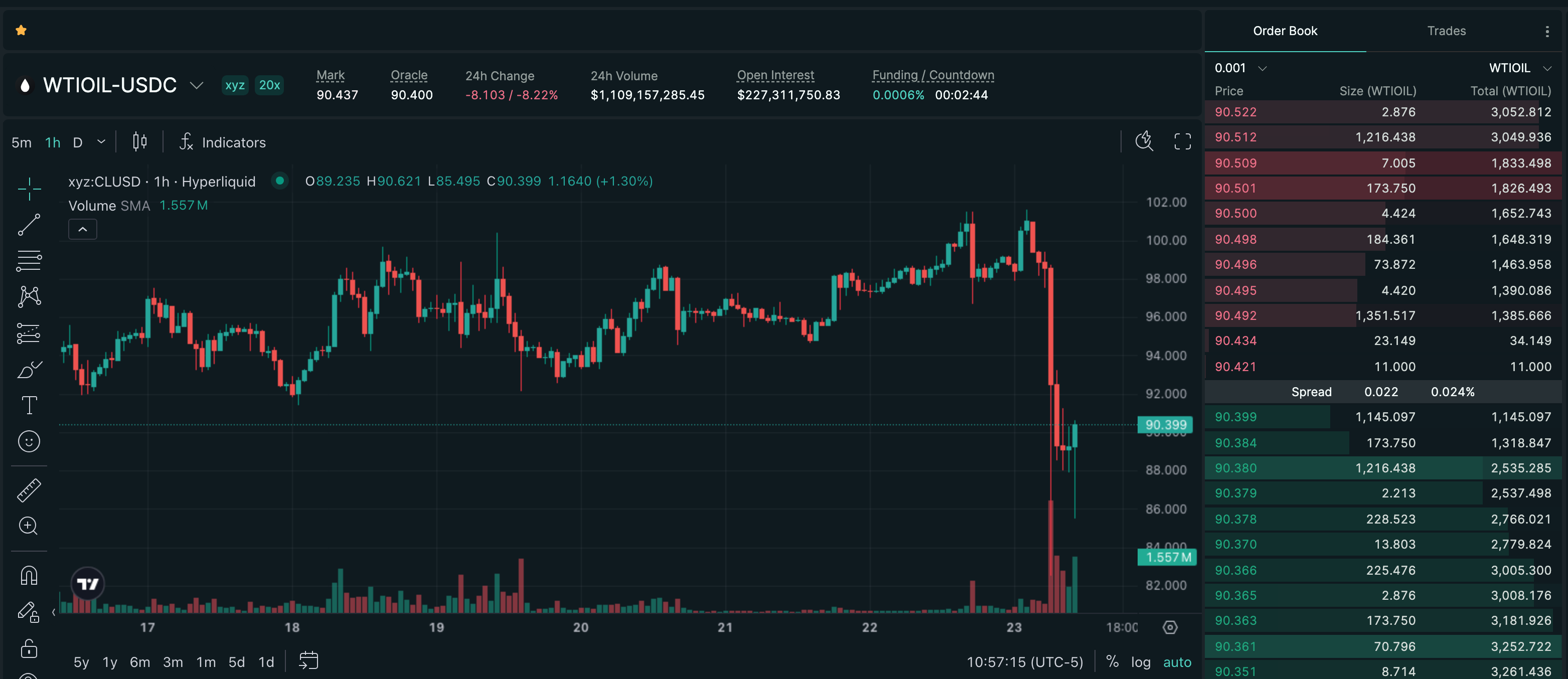
WTI crude reversed from above $100 to under $90 in a single session after Trump announced a five-day postponement of all US military strikes on Iranian power plants and energy infrastructure, claiming productive back-channel talks with Tehran. Iran denied any dialogue took place and framed the pause as a retreat under pressure. The move erased the war premium that had built since Trump's 48-hour Hormuz ultimatum on Saturday, though crude remains roughly 30% above pre-war levels.
Mover Brief
The Catalyst: A Five-Day Window Nobody Asked For
Trump posted on Truth Social Monday morning that he had instructed the Department of War to postpone any and all military strikes against Iranian power plants and energy infrastructure for a five-day period. He claimed the US and Iran had held "very good and productive conversations" about a "complete and total resolution" of hostilities, with envoys Steve Witkoff and Jared Kushner supposedly engaged in back-channel diplomacy.
The timing matters. Just 24 hours earlier, Trump had issued a 48-hour ultimatum demanding Iran reopen the Strait of Hormuz, threatening strikes on power grids and energy infrastructure. Oil had traded above $100 intraday on that escalation. The whiplash from ultimatum to pause took WTI down roughly 13% to $85.66 at the lows — the sharpest single-session drop since the war began February 28.
Iran's response was blunt. The Foreign Ministry denied any dialogue with Washington and framed the postponement as Trump "backing down" after Iran threatened to permanently close the Strait and strike energy infrastructure across Israel and the Gulf states if power plants were hit. Whether this is posturing or substance, the denial injected immediate uncertainty into the de-escalation narrative and kept WTI from testing the $80s.
What Actually Changed — and What Didn't
The honest answer: not much structurally. The Strait of Hormuz remains effectively closed, choking roughly 20 million barrels per day of seaborne oil trade. Iraq's force majeure on foreign-operated oilfields still holds, keeping 2.4 million bpd offline from Basra. Iran's strikes on Gulf energy infrastructure — including Qatar's Ras Laffan LNG terminal and Kuwait's Mina Al-Ahmadi refinery — caused physical damage that takes years to repair regardless of any ceasefire.
What changed is positioning. The war premium that traders had rebuilt over the past week — pricing in the risk of strikes on Iranian power plants — unwound in hours. Brent dropped 14% to around $97, natural gas fell 6%, European gas futures lost 9%, and heating oil dropped 12%. The Dow gained over 1,100 points as equities priced in lower energy costs.
But this is the third de-escalation signal in two weeks — after Treasury's 140 million barrel sanctions waiver and Trump's earlier "winding down" post — and every prior signal has been walked back within 48 hours by troop deployments, new strikes, or Iranian retaliation. The pattern is escalation, rhetorical de-escalation, then re-escalation. Crude is still up 30% since the war began and 50% year-to-date.
Why the Floor Keeps Rising
Even at $89, WTI is well above where anyone would price it without active Hormuz disruption. The Dallas Fed's disruption model projected $98 per barrel under a one-quarter closure and $115 under a two-quarter scenario. At $89, the market is pricing a resolution that arrives within days, not weeks.
The problem is structural. Every dip this month has been bought because the physical oil market is in crisis independent of headline risk. Dubai spot crude was trading near $138-140 just last week — a $40 premium to WTI futures that no amount of rhetorical de-escalation can close. The WTI-Brent spread remains at its widest in 11 years, confirming that US domestic supply is intact but global physical markets are severely dislocated.
The five-day window expires March 28. If no deal materializes — and Iran insists there are no talks — the strikes resume and the premium rebuilds. If some framework emerges, the market has to weigh it against a month of cumulative infrastructure destruction that no diplomatic handshake can undo. Either way, the floor under crude keeps stepping higher: $65 pre-war, $80 after the first de-escalation head-fake on March 10, and now $85-89 after the third. Each cycle removes less premium than the last.
Sources & Provenance
Citations below are preserved as structured Postgres source rows for this brief.
Citations Preserved
6
Reference links carried forward from the published mover record.
Original Signal
Open source tweetMarket Route
Direct route preserved for readers who want to inspect the tracked Hyperliquid market behind this archive entry.
Already onboarded? Open tracked market- 1CNBC — Trump postpones strikes on Iran power plants and energy infrastructurecnbc.com
- 2NBC News — U.S. stocks rise, oil falls after Trump backs off Iran strikesnbcnews.com
- 3Al Jazeera — Trump postpones military strikes on Iranian power plants for five daysaljazeera.com
- 4Bloomberg — Brent Oil Futures Drop 14% After Trump Delays Strikes on Iranbloomberg.com
- 5CNBC — The economy has a Strait of Hormuz deadline for Trump: Two weekscnbc.com
- 6Reuters — US oil exports rise as WTI-Brent discount hits widest in 11 yearsreuters.com
This content is for informational purposes only and does not constitute financial advice. Trading perpetual futures involves substantial risk of loss.
Trade CL on Hyperliquid
Use referral code HIPERWIRE for 4% off trading fees on your first $25M in volume.
Live Market Metrics
Monitor real-time open interest and funding for CL.