WTI Reclaims $98 as Physical Tightness Overwhelms Treasury's Iranian Oil Waiver
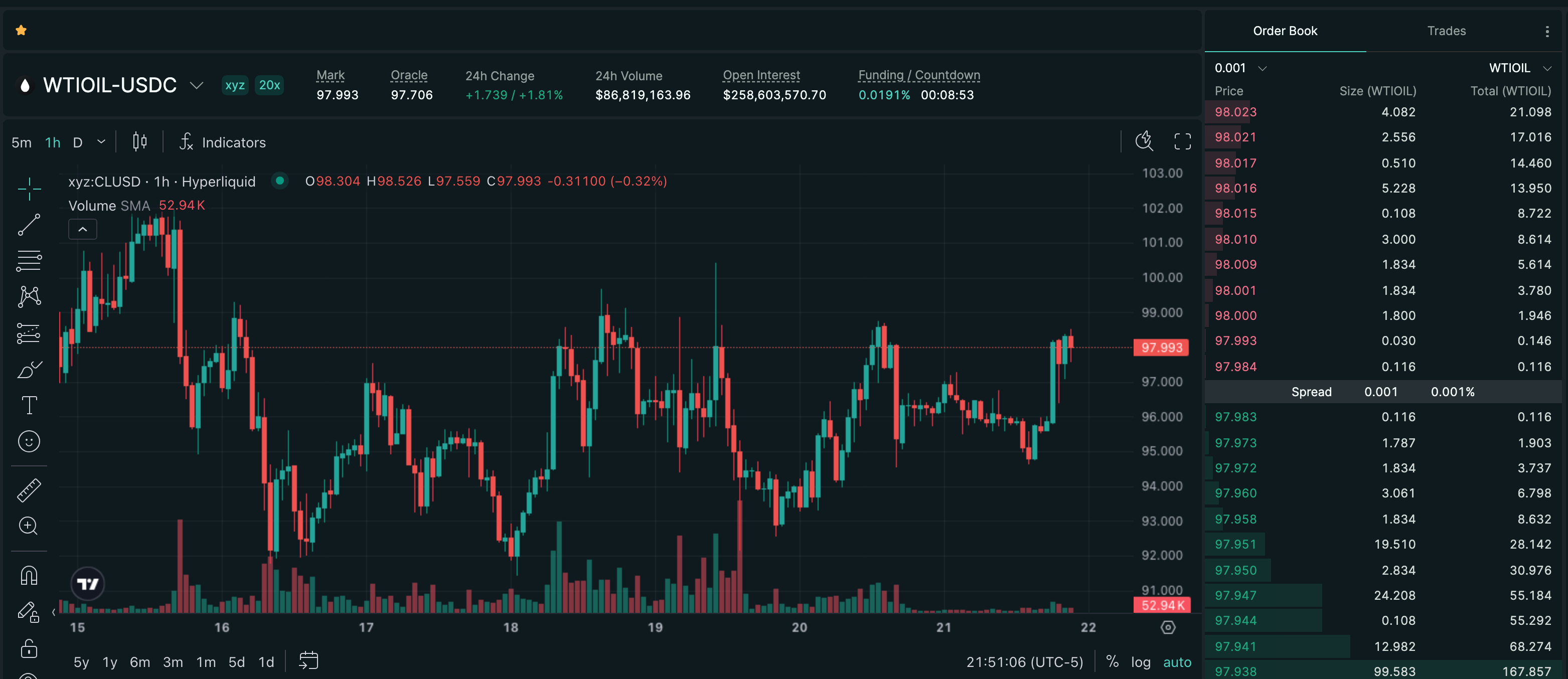
WTI crude bounced more than 3% to $97.98 after Treasury's General License U released 140 million barrels of sanctioned Iranian crude from tankers and briefly pushed prices toward $93. The reversal reflects a physical oil market in crisis mode — Dubai spot crude near $140 per barrel against sub-$100 WTI futures, record front-month backwardation, and a structural 10 million barrel per day supply gap that one-off sanctions waivers cannot close.
Mover Brief
Why the Dip Didn't Stick
Treasury's General License U — authorizing the sale of roughly 140 million barrels of Iranian crude sitting on tankers — was the third supply-side intervention in two weeks, following the IEA's record 400 million barrel strategic reserve release and a temporary waiver on Russian crude. Combined with Trump's Truth Social post about "winding down" the Iran conflict, the market briefly priced out the war premium, pushing WTI toward $93.
It lasted about a session. The 140 million barrels represent roughly 1.5 days of global consumption — noise against a structural deficit where Gulf countries have cut total oil production by at least 10 million bpd since the Hormuz closure began February 28. The "winding down" signal was equally thin: hours after Trump's post, the Pentagon deployed 2,500 more Marines to the region, the second such deployment in a week. When the actions contradict the words, traders price the actions.
The Physical-Futures Disconnect
The story is not WTI at $98 — it is the physical market, which has effectively broken away from paper pricing. Dubai spot crude, the benchmark for Asian refiners who lost access to Gulf supply, is trading near $138 to $140 per barrel — nearly $40 above WTI futures. Front-month backwardation has steepened to $10 to $15 per barrel, the most extreme in at least a decade, signaling that buyers will pay any premium for immediate delivery.
This disconnect explains why every supply-side intervention has failed to hold. The IEA's 400 million barrel reserve release — the largest in its history — moved Brent by roughly $5 for two days before physical tightness pulled prices back. Treasury's Iranian tanker barrels are following the same pattern. These interventions address paper market sentiment. The problem is physical barrels not reaching refineries.
The Dallas Fed's Hormuz disruption model projects WTI at $98 per barrel in Q2 under a one-quarter closure scenario — almost exactly the current price. If the closure extends to two quarters, their model puts WTI at $115. Futures are pricing the optimistic case. The physical market is pricing something worse.
Cumulative Damage, Rising Floor
The floor under WTI keeps rising because the infrastructure damage is cumulative and does not reverse with a ceasefire. Iraq's force majeure on all foreign-operated oilfields took 2.4 million bpd offline from Basra — equivalent to Brazil's entire daily output. Iranian drones struck Kuwait's Mina Al-Ahmadi refinery, the country's largest at 346,000 bpd capacity. Qatar's Ras Laffan LNG terminal lost 17% of export capacity with repairs estimated at three to five years.
Meanwhile, the WTI-Brent spread at $12+, its widest in 11 years, confirms that US domestic supply is intact — EIA reported crude inventories up 6.2 million barrels for the week ending March 13. American crude is not supply-constrained. But WTI cannot stay cheap when global physical premiums are $40 above it and Asian refiners are bidding for every non-Gulf barrel available. At $97.98, the market is pricing a Hormuz reopening that has no diplomatic framework behind it. Every dip this month has been bought.
Sources & Provenance
Citations below are preserved as structured Postgres source rows for this brief.
Citations Preserved
7
Reference links carried forward from the published mover record.
Original Signal
Open source tweetMarket Route
Direct route preserved for readers who want to inspect the tracked Hyperliquid market behind this archive entry.
Already onboarded? Open tracked market- 1Dallas Fed — Strait of Hormuz Closure Economic Impact Analysisdallasfed.org
- 2IEA Oil Market Report, March 2026iea.org
- 3CNBC — Oil Tops $112 After Iraq Force Majeure, Treasury Weighs Iranian Crudecnbc.com
- 4NPR — Trump Mulls 'Winding Down' Even as More Marines Deploynpr.org
- 5OilPrice — Iran Strikes Kuwait's Mina Al-Ahmadi Refineryoilprice.com
- 6Reuters — US Crude Stocks Rise 6.2 Million Barrelsreuters.com
- 7Al Jazeera — Strategic Oil Release Cannot Fix Hormuz Disruptionaljazeera.com
This content is for informational purposes only and does not constitute financial advice. Trading perpetual futures involves substantial risk of loss.
Trade CL on Hyperliquid
Use referral code HIPERWIRE for 4% off trading fees on your first $25M in volume.
Live Market Metrics
Monitor real-time open interest and funding for CL.