Crude Drops 12% After Ghalibaf Calls Trump Iran Talks 'Fake News'
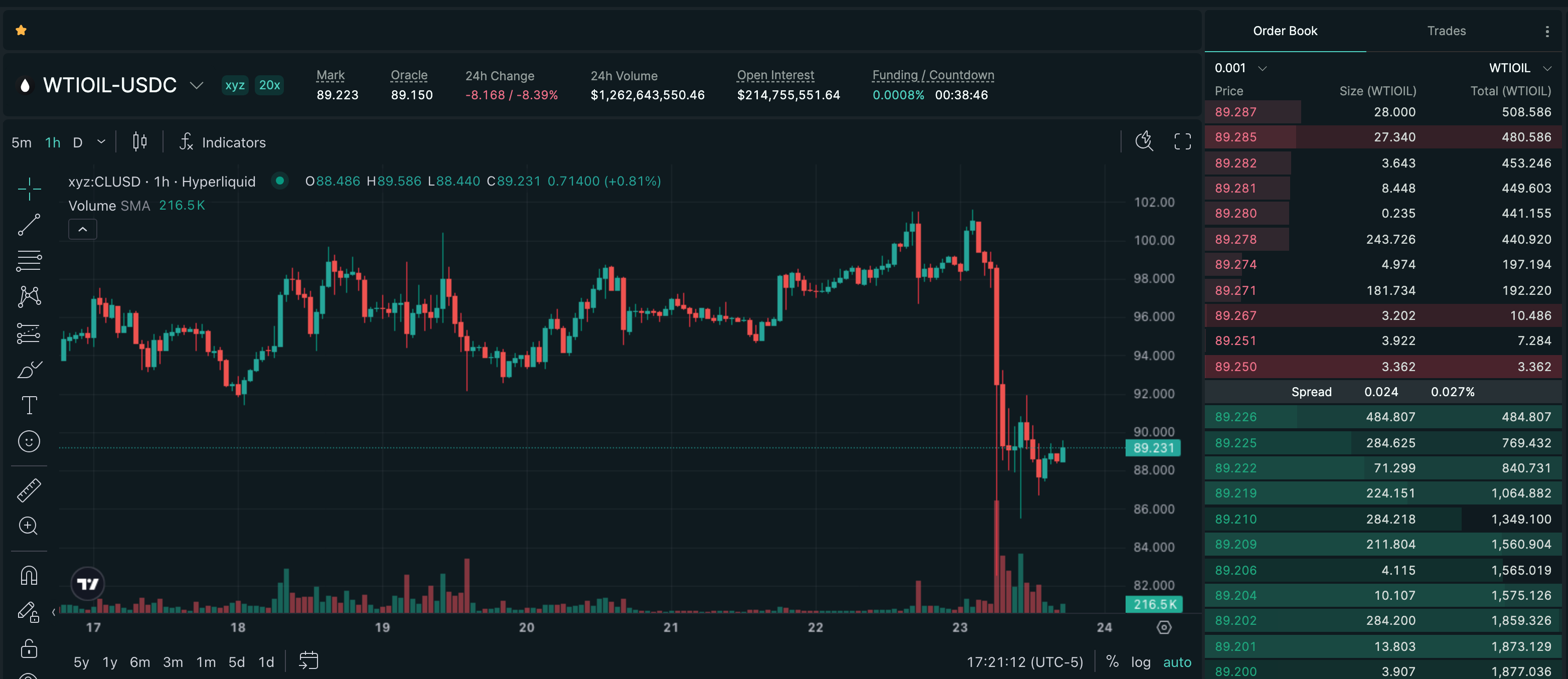
WTI crude held near $89 after a 12% single-session selloff as the negotiation picture between Washington and Tehran sharpened on both ends. An Israeli official identified Iranian parliament speaker Mohammad Bagher Ghalibaf as Trump's back-channel counterparty, the first named interlocutor this conflict has produced. Ghalibaf publicly called the talks fake news designed to manipulate financial and oil markets, while mediating countries pushed to convene a face-to-face between senior American and Iranian officials in Islamabad this week.
Mover Brief
The Named Channel
An Israeli official confirmed to Axios that US envoys Steve Witkoff and Jared Kushner had been in contact with Mohammad Bagher Ghalibaf, the speaker of Iran's parliament. This is the first time either side has identified a specific counterparty in what Trump called "very good and productive conversations" about ending the conflict.
Ghalibaf is a pragmatist by Iranian standards — a former Tehran mayor and IRGC commander who ran for president in 2024 and has historically signaled openness to economic engagement with the West. That he was named, rather than a hardline IRGC figure or an anonymous intermediary, suggests the back-channel is oriented toward a dealmaker rather than a military command structure.
His public response was a flat denial. Ghalibaf posted on social media that "no negotiations have been held with the US" and characterized Trump's claims as "fake news" intended to "escape the quagmire in which the US and Israel are trapped" and to "manipulate financial and oil markets." That last phrase stands out: a named Iranian official directly accusing the US president of fabricating negotiation claims to move commodity prices.
Iran's Foreign Ministry added a layer of nuance that the hard denial doesn't quite capture. Spokesman Esmaeil Baghaei confirmed Iran had received "messages from some friendly countries regarding the US's request for negotiations" but said no direct bilateral discussions occurred. The distinction matters — Tehran acknowledges back-channel messaging through intermediaries while denying it constitutes negotiations.
The Islamabad Proposal
Behind the public denials, a multi-country mediation effort has taken shape. NPR reported that Pakistan, Turkey, and Egypt are facilitating communications between Washington and Tehran, with Egypt's president visiting Gulf capitals in recent days. Iran's president and foreign minister have held phone calls with officials in all three countries. Mediating nations are attempting to convene a face-to-face meeting this week in Islamabad between senior American and Iranian officials — the first proposed physical meeting location since the conflict began on February 28.
The Swiss Foreign Ministry separately confirmed a "mutual de-escalation framework" had been reached, the most substantive claim from any party and one that neither belligerent has publicly acknowledged. Combined with the Ghalibaf identification and the Islamabad push, this represents more diplomatic infrastructure than the prior two de-escalation attempts produced.
Meanwhile, Iran is quietly demonstrating selective de-escalation at the strait itself. Two Indian-flagged LPG carriers, the Jag Vasant and Pine Gas, transited Hormuz on March 23 carrying 92,600 metric tons of LPG along a route hugging Iran's coastline. India's foreign minister described the passage as proof of "what diplomacy could achieve," though he clarified there is no blanket arrangement — each transit is negotiated individually. Iran, China, India, and a handful of other countries can move cargo through Hormuz. Everyone else stays out. The strait is not open, but it is not uniformly closed — and that asymmetry is itself a negotiating chip.
Five Days for What, Exactly
Trump's five-day window expires March 28, but the demands attached to it have expanded well beyond reopening the Strait of Hormuz. He now wants zero uranium enrichment and surrender of Iran's enriched stockpiles, has floated shared US-Iran control of the strait, and questioned whether Supreme Leader Mojtaba Khamenei is still alive — framing regime change as something that has "already happened."
That turns a military de-escalation into a comprehensive negotiation that historically requires years and multiple diplomatic frameworks. The JCPOA took two years of intensive multilateral talks to complete. Compressing a broader outcome into five days, while simultaneously bombing the other party, is not a realistic timeline.
Professor Hassan Ahmadian told Al Jazeera that Trump used the negotiation claim to back away from his 48-hour Hormuz ultimatum, "which would have further escalated the conflict." Analyst Elmasry described it as a "dignified exit" strategy. At $89, WTI is pricing the strike pause itself — not the expanded demands. If the Islamabad channel produces a real meeting, crude has room to retest the low $80s. If the window expires empty, this becomes the third unwound de-escalation trade of the month, and the war premium floor steps up from $85 toward $90.
Sources & Provenance
Citations below are preserved as structured Postgres source rows for this brief.
Citations Preserved
7
Reference links carried forward from the published mover record.
Original Signal
Open source tweetMarket Route
Direct route preserved for readers who want to inspect the tracked Hyperliquid market behind this archive entry.
Already onboarded? Open tracked market- 1Axios: U.S. negotiating with senior Iranian officialaxios.com
- 2Al Jazeera: Iran denies any talks with US after Trump claimsaljazeera.com
- 3NPR: Trump says the U.S. is in talks with Iran, which Iran deniesnpr.org
- 4Jerusalem Post: Trump pitches shared US-Iran Hormuz controljpost.com
- 5Times of Israel: Ghalibaf calls Trump claims 'fake news' to manipulate marketstimesofisrael.com
- 6Energy Connects: Indian LPG ships transit Hormuz along Iran coastenergyconnects.com
- 7Al Jazeera: Trump postpones military strikes on Iranian power plantsaljazeera.com
This content is for informational purposes only and does not constitute financial advice. Trading perpetual futures involves substantial risk of loss.
Trade CL on Hyperliquid
Use referral code HIPERWIRE for 4% off trading fees on your first $25M in volume.
Live Market Metrics
Monitor real-time open interest and funding for CL.