WTI Reverses Full De-Escalation Drop After Iran Rejects Trump's 15-Point Peace Plan
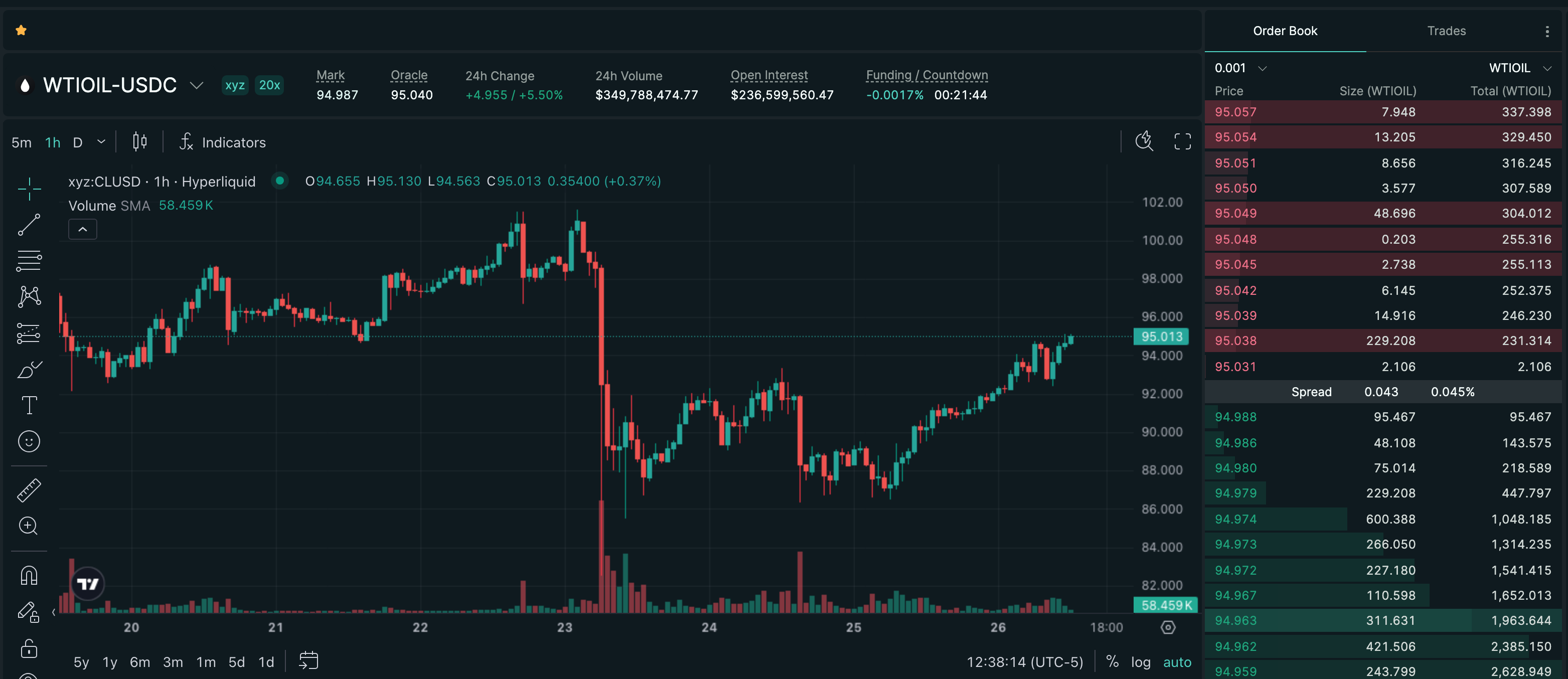
WTI crude snapped back over 5% on March 26 after Iran's Foreign Minister Araghchi publicly rejected Trump's 15-point ceasefire proposal and denied any direct talks with Washington. The reversal erased the prior day's de-escalation sell-off in full, marking the fourth failed diplomatic off-ramp this month. Strait of Hormuz transit has collapsed to single-digit vessel counts.
Mover Brief
The Reversal
WTI crude jumped over 5% to $95 on March 26, fully erasing the prior session's sell-off that came after Trump claimed the US and Iran were "in negotiations right now." The catalyst for the snap-back was Iranian Foreign Minister Abbas Araghchi telling state media that Tehran is "not engaged in direct talks with Washington" and has "no intention of negotiating for now." The White House responded by warning Iran would be "hit harder" than ever before if it did not accept military defeat.
This is the fourth time in March that the market has priced in a diplomatic breakthrough only to see it collapse within 48 hours. Trump's five-day strike pause, the Islamabad back-channel, the Swiss mediation framework — all were walked back. The pattern is clear: WTI drops 5–12% on de-escalation headlines, then recovers the full move once the headline falls apart.
Hormuz by the Numbers
The fundamental reason these diplomatic head-fakes keep failing to stick is that the Strait of Hormuz remains effectively closed. Automatic identification system data showed just 4 vessel transits on Tuesday — down from 120 daily before the conflict. Iran claims the strait remains open to non-aligned shipping, but the traffic data says otherwise. Iran's parliament is now pursuing legislation to formally codify sovereignty over the strait and impose transit fees, a move that would make any reopening contingent on Iranian terms.
An estimated 6–7 million barrels per day of Gulf crude capacity remains shut in. Iraq alone has curtailed at least 2 million bpd. Dubai physical crude hit a record $166.80 per barrel, blowing the Dubai-WTI spread out to over $70 — a gap that underscores how disconnected American benchmark pricing is from actual global physical tightness.
Bearish Data, Bullish Positioning
The EIA's weekly report added a bearish data point: US crude inventories rose 6.9 million barrels for the week ending March 20, against expectations of a 1.3 million barrel draw. API stocks built 2.3 million barrels the week prior. Under normal conditions, back-to-back builds of that magnitude would pressure prices.
But conditions are not normal. US inventories sit at 443 million barrels, about 2% below the five-year average, and the builds reflect a domestic market awash in shale barrels that cannot find export routes while the strait is closed. The Brent-WTI spread above $12 — widest in over a decade — captures this dynamic: WTI is artificially depressed relative to the global barrel because American crude has nowhere to go. Analysts at multiple desks have flagged $135 Brent as a realistic target if the current disruption persists through summer.
What Breaks the Pattern
The market has now seen enough failed off-ramps to treat any new headline with deep skepticism. Each successive de-escalation trade has been shallower and shorter-lived — the latest lasted less than 24 hours. For WTI to sustainably shed its war premium, the market likely needs to see actual vessel traffic resume through Hormuz, not just a press conference. Iran codifying strait sovereignty through legislation raises the bar further — a parliamentary act is harder to reverse than an executive order.
Trump's 15-point plan reportedly drew counterproposals from Tehran even as Iran launched fresh missile strikes on Israel. That combination — negotiate and escalate simultaneously — suggests Iran sees time as an ally while oil above $100 funds its war effort. Until that calculus changes, the default direction for crude is up, and the diplomatic dips are selling opportunities, not trend reversals.
Sources & Provenance
Citations below are preserved as structured Postgres source rows for this brief.
Citations Preserved
6
Reference links carried forward from the published mover record.
Original Signal
Open source tweetMarket Route
Direct route preserved for readers who want to inspect the tracked Hyperliquid market behind this archive entry.
Already onboarded? Open tracked market- 1Al Jazeera — Oil prices rise as Iran denies US talksaljazeera.com
- 2Euronews — Conflicting Iran-US messages fuel uncertaintyeuronews.com
- 3Down to Earth — Oil jumps as Iran denies talksdowntoearth.org.in
- 4FX Leaders — WTI battles $92 as Iran rejects peace planfxleaders.com
- 5EIA Weekly Petroleum Status Reporteia.gov
- 6Reuters — US oil prices rise as investors assess Middle Eastreuters.com
This content is for informational purposes only and does not constitute financial advice. Trading perpetual futures involves substantial risk of loss.
Trade CL on Hyperliquid
Use referral code HIPERWIRE for 4% off trading fees on your first $25M in volume.
Live Market Metrics
Monitor real-time open interest and funding for CL.